
How to Search Pinellas County Court Records
The Clerk "View Records" page is the correct starting point for a Pinellas County court records search. From there, the Clerk splits records into two systems. Court Records Public View covers case dockets, criminal case filings, civil pleadings, and traffic records for most cases. The Official Records portal covers recorded instruments such as deeds, mortgages, liens, judgments, plats, marriage licenses, and powers of attorney. Those are separate tools and serve separate purposes. Most people looking for a criminal case, traffic ticket, or civil lawsuit should start with Court Records Public View. Family and probate cases require a registered user login for online document viewing.
Before searching, gather whatever you know about the case. A case number is fastest. Pinellas criminal case numbers often appear in a short format like 25-01828-CF-1, where the two-digit year, a sequence, and a type code are combined. The same case may also have a longer statewide Uniform Case Number such as 522020CF000088000APC. Either format can work in the Clerk portal. If you have no case number, searching by party name returns cases across all categories. Use broad spelling variations, especially for names with possible alternate spellings, since the portal searches for exact matches.
- Go to the Clerk View Records page and select Court Records Public View for no-login access to many criminal, civil, and traffic records.
- Enter the case number if you have it. Try both the short Clerk format and the longer Uniform Case Number format if the first search returns nothing.
- If no case number is available, search by party name. Try spelling variations and maiden names for older filings.
- Use the Court Calendar option if your goal is an upcoming hearing date rather than a document. The calendar and the case docket are separate views.
- If a document is not visible online, check whether the case is family, probate, or juvenile. Family and probate cases require registered access. Juvenile records are not available online at all; those must be requested in person at the Pinellas County Justice Center with valid photo ID.
- For certified copies, conformed copies, exemplified certificates, or any document that is not downloadable from the public portal, use the Clerk public records request center. The Clerk will quote the cost by email before fulfilling the request.
- For very old records stored on paper or microfilm, call the civil records desk at (727) 464-3904 before visiting so staff can pull the file from storage.
The court records public portal also separates anonymous access, registered user access, and attorney access. Anonymous users can search and view most criminal, civil, and traffic case information without creating an account. Registered users get access to family and probate records within the limits Florida law allows. Attorneys of record have broader access to confidential documents on cases where they are listed as counsel. If one access level does not return what you expect, try logging in or requesting the record directly.
The screenshot below shows the Pinellas County Clerk of the Circuit Court and Comptroller homepage, the main gateway to court records, online payments, marriage licenses, and office news.
Visit the Clerk homepage at mypinellasclerk.gov
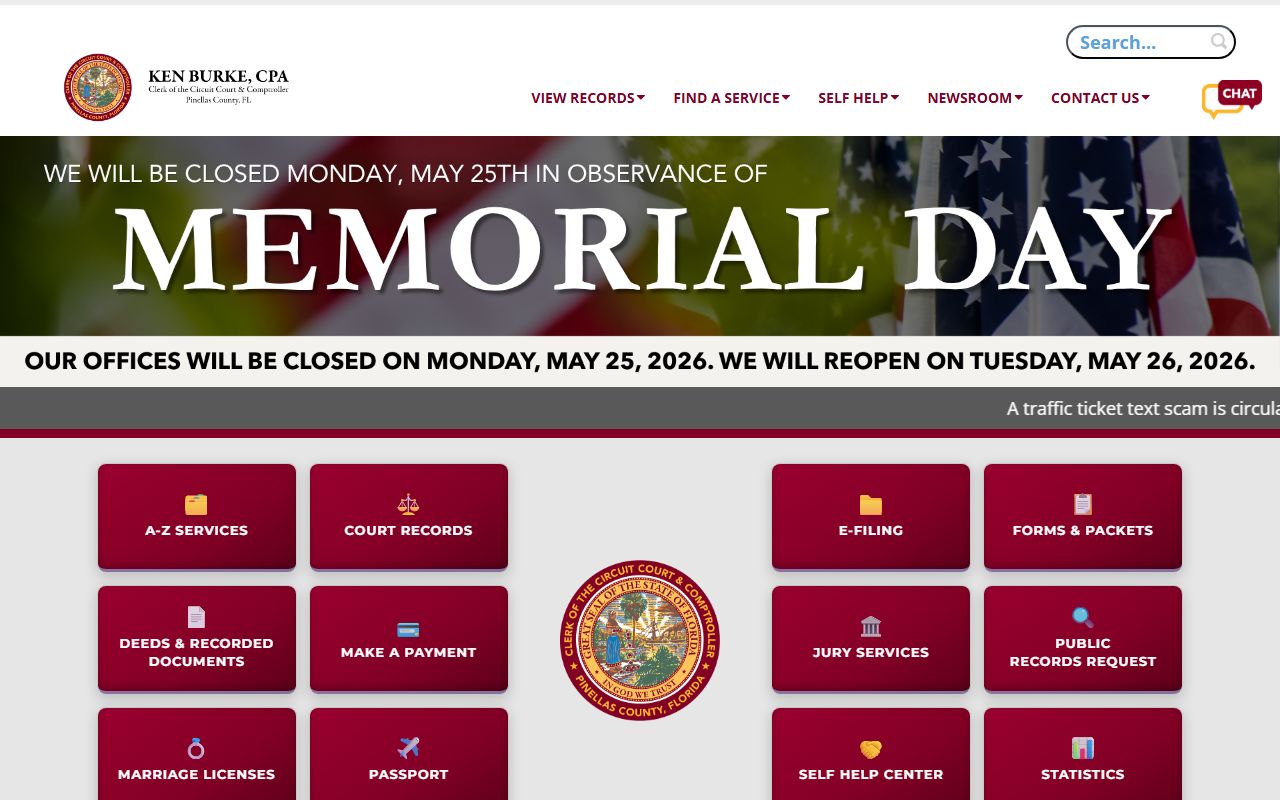
The Clerk homepage provides direct links to court records, official records, payments, and news about the office. It is the most reliable starting point for any Pinellas County records search.
The View Records page, shown below, lists all record access options including the public court portal, the registered user and attorney logins, the Official Records search, and the copy request center.
Visit the Clerk View Records page
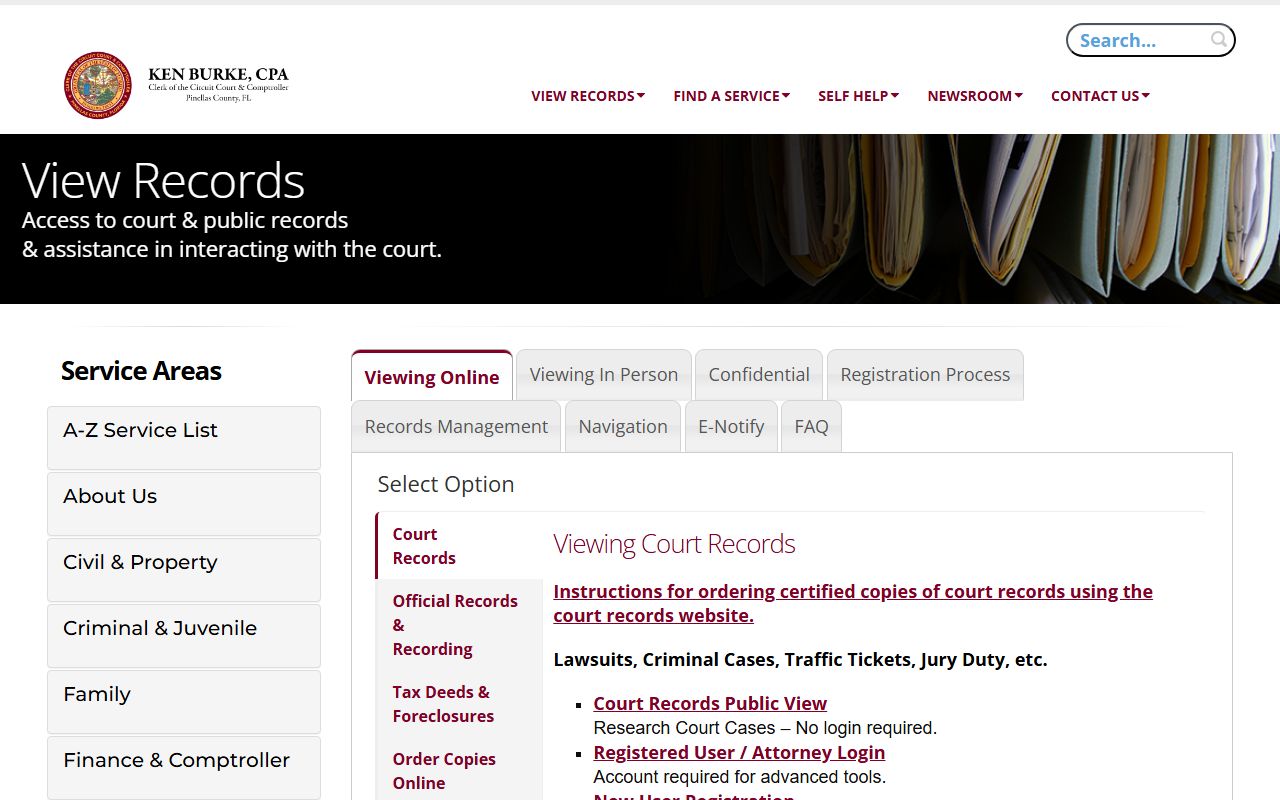
This page organizes the Clerk's public access model by record type and access level, making it clear which portal to use for a court case versus a recorded deed or marriage license.
The court records search portal itself offers name, case number, and category search options across criminal, civil, traffic, and other case types.
Visit the Pinellas court records search portal
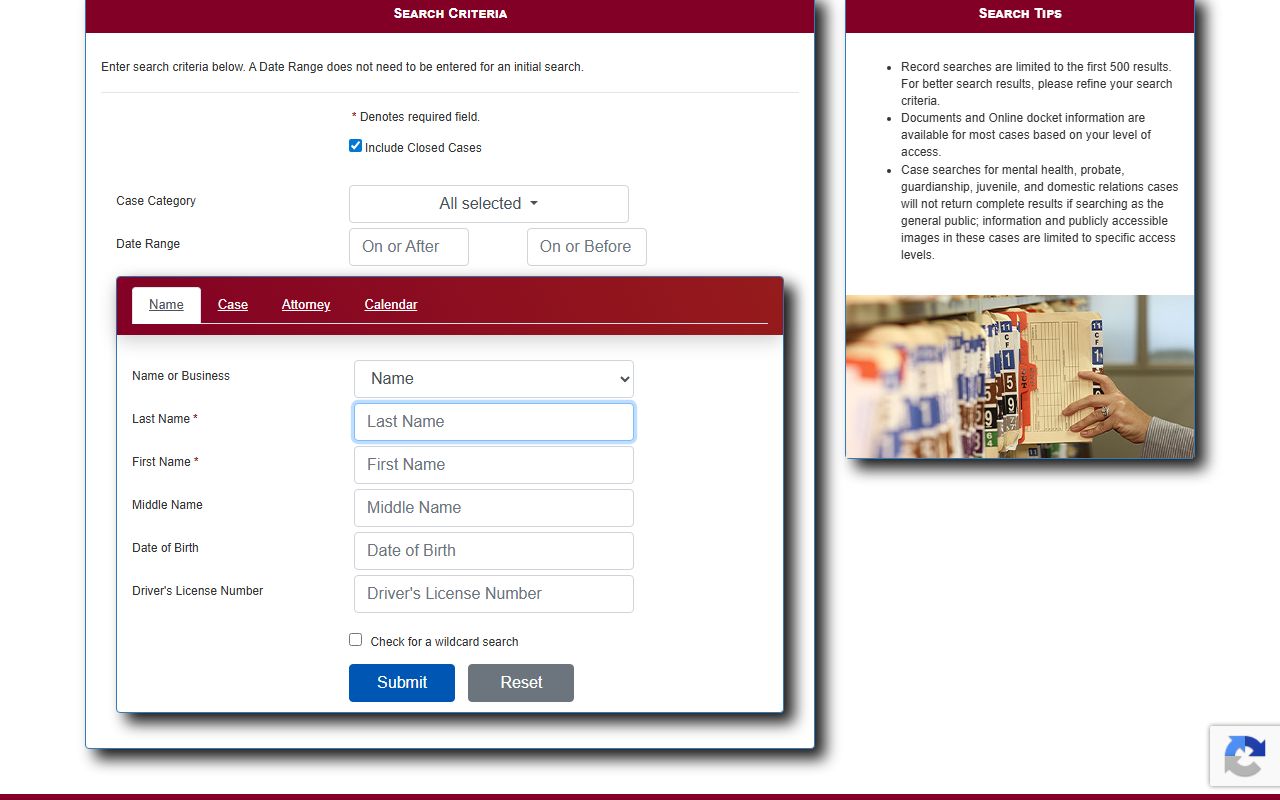
The portal is free to use without registration for most criminal, civil, and traffic cases. Family and probate documents require a registered login because Florida law restricts broader public access to those case types.
The Official Records portal below handles recorded documents like deeds, mortgages, marriage licenses, and liens. It is a separate system from the court case portal.
Visit the Pinellas Official Records portal
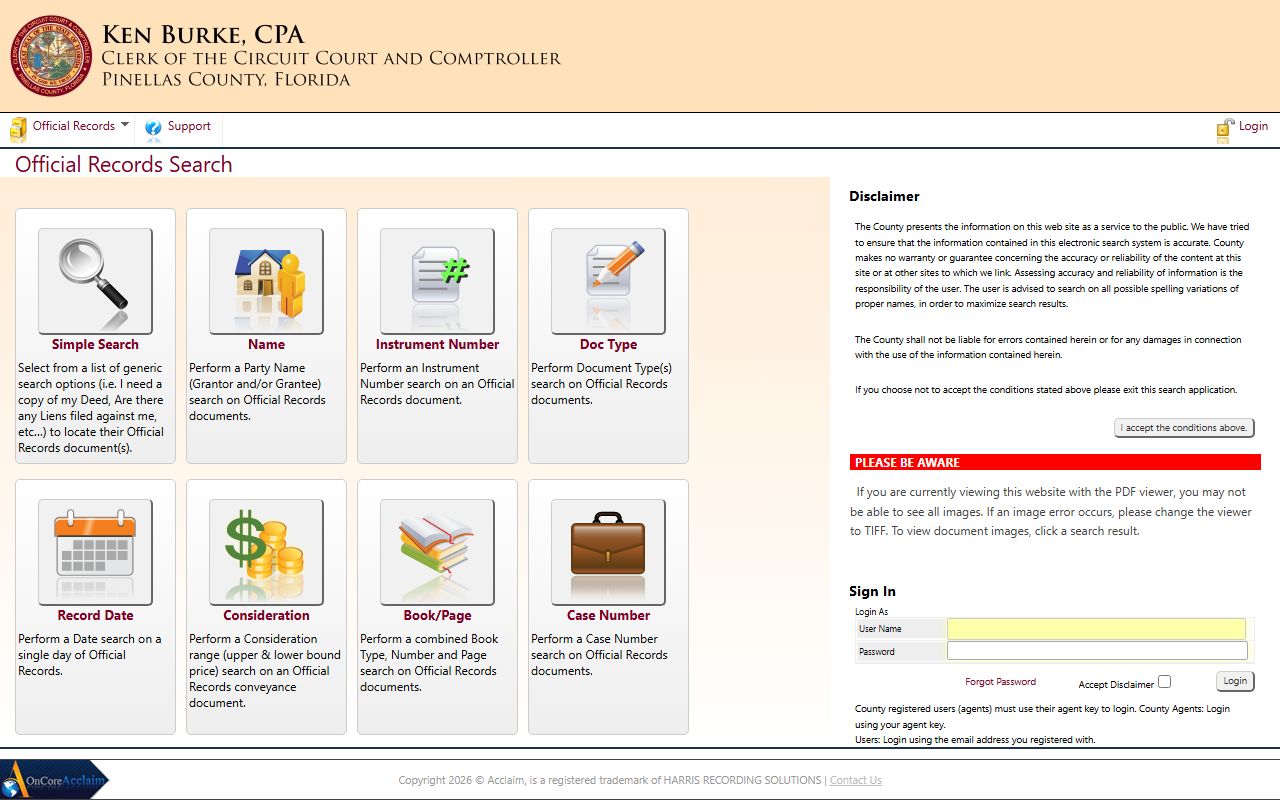
Use the Official Records portal when searching for deeds, liens, judgments recorded as lien instruments, marriage licenses, or powers of attorney. If you are looking for a lawsuit or criminal case docket, use the court records portal instead.
Pinellas County Court Records Search Fields
The Clerk court records portal and the Official Records portal each offer distinct search fields. Knowing which fields to use can save time and prevent missed results. The table below lists the fields available for court case searches.
| Field Label | Type | Required | Notes |
|---|---|---|---|
| Case Number | Text | Optional | Short Clerk format (e.g., 25-01828-CF-1) or long Uniform Case Number format. |
| Party Name | Text | Optional | Search by person or business name when case number is unknown. Try spelling variations. |
| Court Calendar | Tab/Filter | Optional | Use for upcoming hearing date information rather than docket history. |
| Case Type / Category | Dropdown/Tab | Optional | Criminal, civil, traffic visible via Public View; family/probate require registered login. |
| Date Range | Date fields | Optional | Attorney and registered views may filter by active/inactive status within a date range. |
| Attorney / My Cases | Checkbox/Filter | Attorney only | Attorney tab populates with bar number for cases where attorney is on record. |
| Register / Login | Link | Conditional | Required for registered user, attorney, or gatekeeper access levels. |
Note: The Clerk record search fee of $7.00 per name applies when Clerk staff perform the search, not when users search the public portal themselves. Online queries through Public View are free.
The Pinellas County Judicial System
Florida uses a two-tier trial court system. Circuit courts are the courts of general jurisdiction, and county courts are the courts of limited jurisdiction. Pinellas County belongs to the Sixth Judicial Circuit, which also serves Pasco County. The Sixth Circuit describes itself as Florida's third-largest trial court and nationally recognized for court automation. The circuit has 69 judges total: 45 circuit judges and 24 county judges. Pinellas County specifically has 30 circuit judges and 17 county judges across five court facilities in Clearwater and St. Petersburg.
Above the trial courts, Florida's appellate system routes most Pinellas trial-court appeals to the District Courts of Appeal. Above those sit the Florida Supreme Court. Federal cases arising in Pinellas County are separate from this state hierarchy and are heard by the U.S. District Court for the Middle District of Florida, Tampa Division.
Case flow: County Court › Circuit Court › District Court of Appeal › Florida Supreme Court
| Court | Jurisdiction | Case Types |
|---|---|---|
| Circuit Court | General jurisdiction; felonies, civil over $50,000, family, probate | Felony criminal, circuit civil, family/divorce, probate/guardianship, juvenile, mental health |
| County Court | Limited jurisdiction; misdemeanors, civil up to $50,000, small claims | Misdemeanor criminal, county civil, small claims ($8,000 or less), landlord-tenant, traffic infractions |
| District Court of Appeal | Intermediate appellate review | Appeals from circuit and county court decisions |
| Florida Supreme Court | Final state appellate authority | Certain appeal categories, constitutional questions, death penalty cases |
The Sixth Judicial Circuit operates divisions by case type, then assigns cases to a judge within the division. Major divisions include Circuit Civil, Circuit Criminal, Family, Unified Family Court, Probate and Guardianship, County Civil, County Criminal, Traffic, and Small Claims. Each division has its own docket rules and filing requirements. A case filed as a felony in Circuit Criminal and resolved at sentencing may later have documents in Probate if the sentence involves restitution or in Official Records if a judgment lien is recorded. The build should always check the correct portal for each stage.
The Sixth Circuit homepage is shown below, with links to court divisions, public programs, calendar, and local news.
Visit the Sixth Judicial Circuit homepage at jud6.org
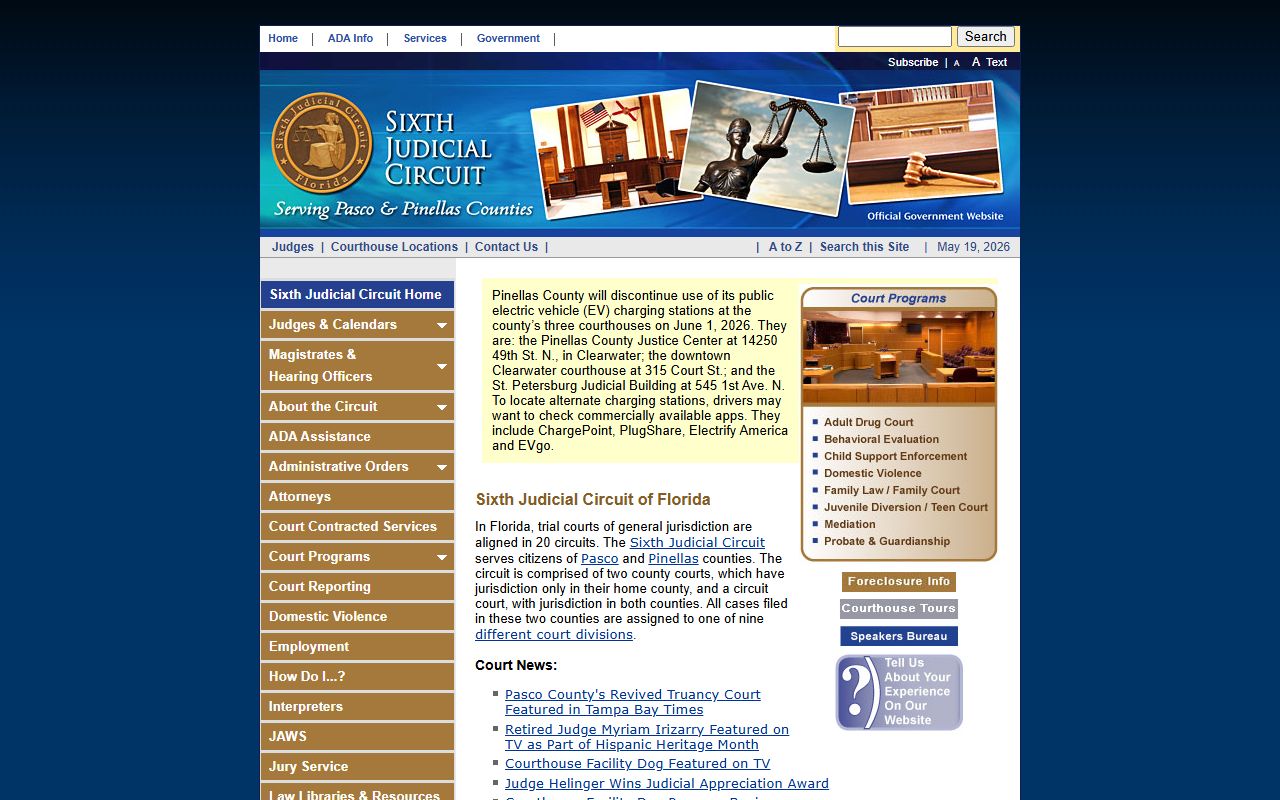
The Sixth Circuit site lists court programs, administrative orders, judicial assignments, and public resources for both Pinellas and Pasco counties. The addresses and directions page on the site identifies every active court facility.
Pinellas County Courthouses and Facilities
Pinellas County court operations are spread across several buildings rather than one central courthouse. The main civil, probate, and official records building is the Clearwater Courthouse at 315 Court Street. Criminal court operations, criminal records, and jury service are at the Pinellas County Justice Center on 49th Street North. A judicial building in St. Petersburg serves South County users and includes a Self Help Center. A North County branch and the historic courthouse round out the active locations. Before traveling, verify the correct building for the specific service needed, because not every division operates from every location.
St. Petersburg Judicial Building
545 1st Avenue North
St. Petersburg, FL 33701
(727) 582-7941
The Clearwater Courthouse holds circuit and county civil court records, family and child support services, official records, probate court records, recording services, and administrative offices. The Justice Center holds criminal court records, criminal court customer services, and jury service. The St. Petersburg Judicial Building has a Self Help Center in Room 103. A North County Customer Information and Service Center is located at 3165 McMullen Booth Road, Building B, Clearwater, FL 33761, useful for residents of north Clearwater, Safety Harbor, Oldsmar, Dunedin, Palm Harbor, and Tarpon Springs.
Public view terminals are available at the Clearwater Courthouse, Justice Center, North County branch, and St. Petersburg building. These terminals let users inspect records that may not be remotely accessible, subject to confidentiality restrictions.
The Clerk contact and locations page shows all offices and departments.
Visit the Clerk contact and locations page
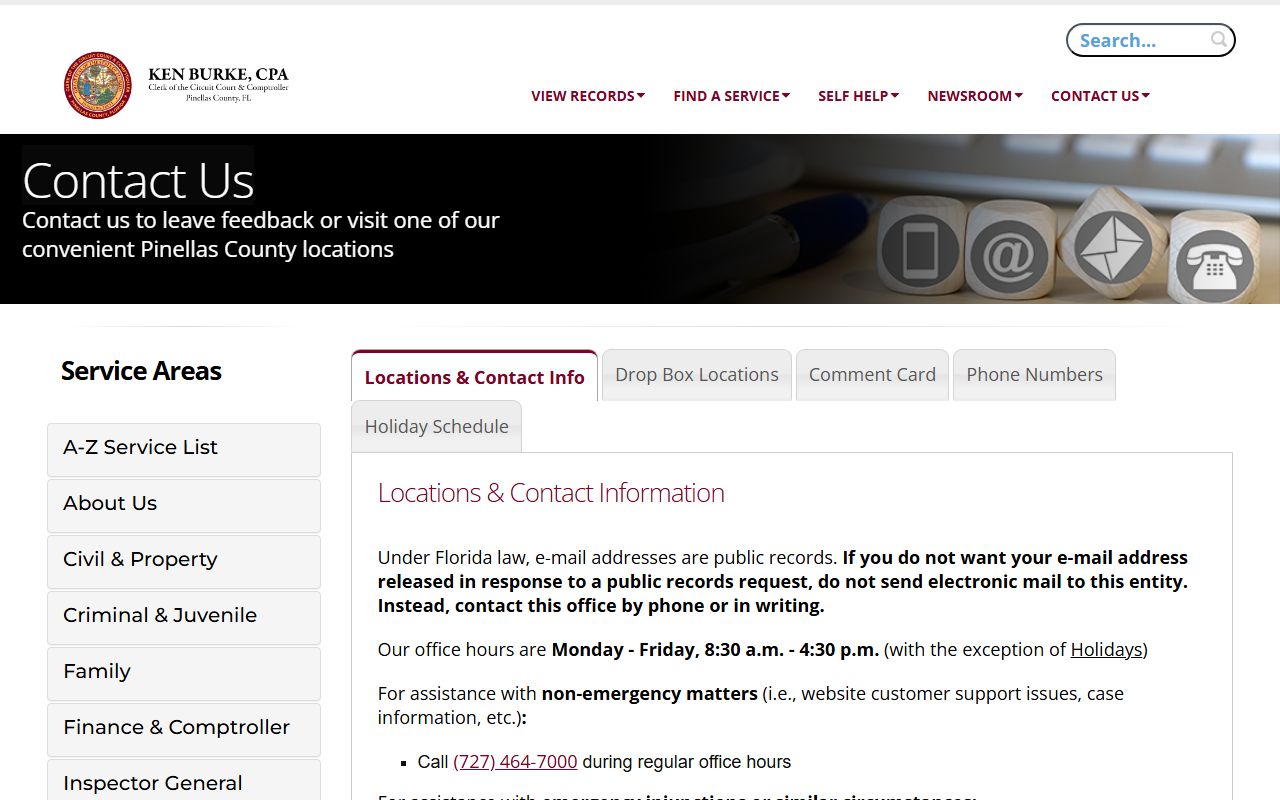
The contact page lists department-specific phone numbers, physical locations, and service descriptions for every Clerk office in Pinellas County. Check this page before visiting to confirm the correct room number and service location.
Types of Court Records Available in Pinellas County
The Pinellas Clerk maintains a wide range of court record types across multiple divisions. Circuit Court produces felony criminal records, circuit civil records, family records including divorce and custody, and probate records. County Court produces misdemeanor criminal records, county civil records, small claims case records, landlord-tenant filings, and traffic and ordinance records. The Clerk also maintains Official Records, which are recorded instruments rather than case dockets. These are separate from court cases even though some court judgments are later recorded into Official Records as lien instruments.
Knowing which division produced a record helps you search the right portal. A felony case has a CF suffix in the case number. A misdemeanor has MM. A traffic case may have a separate traffic case number. Family cases are in the family division and require registered access for most document viewing. Probate cases are in the Probate and Guardianship Division at Clearwater Courthouse Room 106.
- Criminal records - Felony cases in Circuit Criminal Court at the Justice Center; misdemeanor cases in County Criminal Court. Includes arrest-related filings, charges, pleas, sentences, and probation orders.
- Civil records - Circuit civil covers disputes over $50,000, foreclosure, real property, and most large contract cases. County civil covers disputes at $50,000 or less, landlord-tenant evictions, and simplified dissolutions.
- Family and divorce records - Divorce, custody, time-sharing, paternity, adoption, domestic violence injunctions, and juvenile matters. Online viewing requires registered access. See marriage and divorce records for details.
- Probate records - Estates, wills, trusts, guardianship, incapacity, Baker Act, and Marchman Act matters. Handled by Probate and Guardianship Division. See Pinellas probate records for details.
- Traffic court records - Civil traffic infractions, criminal traffic cases such as DUI, red-light camera violations, and parking. Most infractions can be paid or contested through the Clerk Traffic and Parking page.
- Small claims - County Court disputes of $8,000 or less, excluding court costs, interest, and attorney fees. Designed for simpler self-represented proceedings.
- Official Records - Recorded instruments such as deeds, mortgages, liens, marriage licenses, affidavits, plats, and powers of attorney. Searched through the Official Records portal, not the court case portal.
What Pinellas County Court Records Show
A Pinellas County court case record includes both case-level information and document-level content. Case-level fields appear in the search results and docket view. Documents attached to the docket may be downloadable, viewable online, restricted to registered users, or available only at a Clerk terminal. Financial identifiers such as Social Security numbers, bank account numbers, and credit and debit card numbers can be redacted from records on request under state law, but driver's license numbers may not be removed under Clerk redaction instructions alone.
| Field | What It Shows |
|---|---|
| Case Number | Local Clerk case number (e.g., 25-01828-CF-1) and sometimes the longer statewide Uniform Case Number. The CF suffix means felony; MM means misdemeanor. |
| Filing Date | Date the case or document was filed with the Clerk. |
| Court and Division | Which court division handled the case: Circuit Criminal, County Criminal, Circuit Civil, County Civil, Family, Probate, Traffic, or Small Claims. |
| Parties | Plaintiff and defendant in civil matters; State and defendant in criminal matters; petitioner and respondent in family or probate matters. |
| Charges or Cause of Action | Criminal offense, civil claim type, family petition type, or probate petition category. |
| Disposition | Final or current outcome: guilty, not guilty, dismissed, nolle prosequi, default judgment, consent order, transferred, or pending. |
| Sentence or Judgment | Jail or prison time, probation, fines, restitution, civil judgment amount, injunction terms, or sentence conditions. |
| Docket Entries | Chronological log of every action: complaint filed, summons issued, return of service, motions, orders, hearing dates, pleas, appeals, satisfaction, and dismissal. |
| Bond and Financial | Bond assessed, bond amount due, payment plan details, fines, court costs, restitution, and garnishment orders. |
| Attorneys | Attorney name, party represented, and bar number where visible. |
Public Access Laws for Pinellas County Court Records
Florida's public records framework is grounded in the state constitution and Chapter 119, Florida Statutes. Every person has the right to inspect or copy public records held by a state or local agency unless the Legislature has created an exemption or the record is otherwise confidential. Court records follow both Chapter 119 principles and a separate judicial branch rule, Florida Rule of General Practice and Judicial Administration 2.420, which governs court files, progress dockets, electronic access, and custodian duties specifically within the judicial branch. Pinellas County's own public records page affirms the Chapter 119 access rights and provides a records liaison contact.
When a custodian claims an exemption, they must identify the specific statutory basis. If a record contains both public and exempt information, the custodian generally redacts only the exempt portion and releases the rest. This is the basis for the Clerk's redaction request process: a user can ask that sensitive personal identifiers such as Social Security numbers or bank account numbers be removed from a document before it is released or posted online.
Key Florida Statutes and Rules for Pinellas County Court Records:
Florida Statutes §119.07 - The core public records inspection section; custodians must produce nonexempt portions and cite the statutory basis for any claimed exemption.
Florida Statutes §119.0714 - Governs court files, court records, and official records exemptions; provides the basis for redaction of sensitive identifiers in Clerk records.
Florida Rule 2.420 - Public access to judicial branch records; defines court records, confidential information, custodian duties, and the process for motions to determine confidentiality.
Florida Statutes §943.0585 - Court-ordered expunction; removes eligible criminal history from ordinary public access and requires agencies to destroy or obliterate covered records subject to statutory exceptions.
Florida Statutes §943.059 - Court-ordered sealing; makes eligible criminal history confidential but does not destroy it; different process and effect from expunction.
The Pinellas County government public records page, shown below, provides additional guidance on Chapter 119 rights and lists agency contacts for records held outside the Clerk and courts.
Visit the Pinellas County public records page
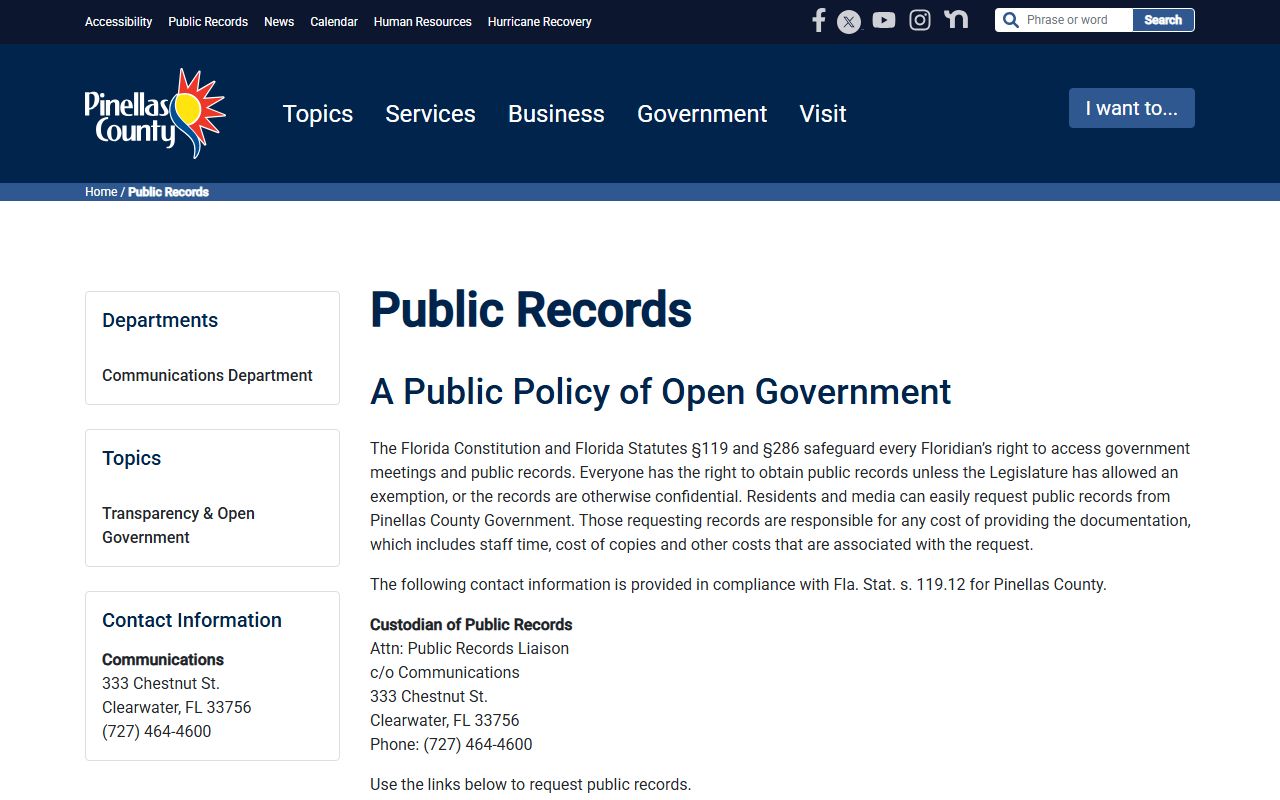
The county public records page notes that constitutional offices such as the Clerk, Sheriff, Property Appraiser, and Tax Collector are separate agencies. A records request sent to the wrong office may be delayed or redirected, so confirm the correct custodian before submitting.
Records That Are Restricted or Confidential
Not all Pinellas County court records are publicly available. Florida law makes certain categories confidential by statute, and courts can also seal records by order. The Clerk's system reflects these restrictions in how records are classified and whether they appear in anonymous public view, registered view, attorney view, or only at courthouse terminals. Juvenile delinquency and dependency records are not available online through the Pinellas Clerk. Juvenile record requests must be made in person by the defendant with valid photo ID at the Justice Center. Adoption records are confidential under Florida Statutes §63.162 except as authorized by statute or court order. Mental health clinical records, including many Baker Act and Marchman Act filings, are protected under Florida Statutes §394.4615.
Sealed criminal records are removed from the public case view after a court order and Clerk processing. Expunged criminal records are removed and agencies are required to destroy or obliterate covered records, subject to statutory exceptions. The sealing and expunction process has two main stages. First, the applicant must complete an FDLE eligibility application, obtain certified copies of dispositions, and mail the packet with a $75 cashier's check or money order payable to FDLE. If FDLE issues a Certificate of Eligibility, the second stage is filing that certificate with the Clerk and paying the current Clerk filing fee of $42 plus any applicable copy, certification, notary, and mailing charges. The State Attorney has an opportunity to respond, and a judge decides whether to grant the order. Common reasons eligibility is denied include prior sealing or expunction, disqualifying charge history, open charges, or missing disposition documents.
Other restricted categories include victim identifying information protected under Marsy's Law and related statutes, financial identifiers such as Social Security and bank account numbers that can be redacted on request, military discharges and death certificates in Official Records which require subscriber access online, and certain protected-address records for victims of domestic violence, stalking, sexual violence, or human trafficking.
Specialty Courts in Pinellas County
The Sixth Judicial Circuit operates several specialty courts and programs in Pinellas County. The court programs page describes each program and its requirements. These programs sit alongside the standard criminal and civil dockets and often involve regular supervision by a designated judge or hearing officer.
Adult Drug Court is a voluntary, court-supervised treatment program for non-violent defendants with substance abuse issues. Participation requires frequent appearances before the drug court judge, substance abuse treatment, and random testing. It is not simply a different docket label; it is a structured compliance program with real consequence for non-participation. Successful completion can lead to reduced or dismissed charges.
Unified Family Court (UFC) is a major Pinellas specialty structure. The Sixth Circuit coordinates multiple cases involving the same family before one judge when possible, reducing conflicts across divorce, dependency, delinquency, and domestic violence dockets. In Pinellas, UFC includes four judges, one general magistrate, behavioral evaluations, and juvenile arbitration. It handles juvenile delinquency and dependency, adoptions of minors (except certain stepparent or relative adoptions), termination of parental rights, temporary custody, and judicial waiver matters. If a family has connected pending cases across divisions, UFC can consolidate those before a single judge.
Other specialty programs include Juvenile Arbitration for first-time misdemeanor offenders, STOP (a longer-term arbitration program for repeat misdemeanor and some third-degree felony juveniles), Juvenile Drug Court, Teen Court, Teen Traffic Court, and Truancy Teen Court. The Community Violence Court handles dating, domestic, repeat, and sexual violence injunction hearings. The Probate Division also runs specialty sections for Marchman Act petitions, risk protection orders, and firearm disability cases.
Pinellas County Sheriff and Jail
The Pinellas County Sheriff's Office is led by Sheriff Bob Gualtieri, who began as a detention deputy in the Pinellas County Jail in 1982. He was appointed Sheriff in 2011 and re-elected in 2012, 2016, 2020, and 2024. The PCSO non-emergency and general information line is (727) 582-6200. For jail-specific information, the number is (727) 464-6415. The Pinellas County Jail is located at 14400 49th Street North, Clearwater, FL 33762-2877, which is near but distinct from the Justice Center's address of 14250 49th Street North.
The Sheriff's arrest inquiry tool ("Who's in Jail") is free and covers people currently in custody and those released within the last 30 days. After 30 days, release records must be requested through the PCSO records request portal. The jail search lets you filter by agency, charge, arrest type, race, sex, docket number, booking date, and address, in addition to the standard name search. Multiple city police departments book arrestees into the county jail, so users who know only the arresting city (Clearwater PD, Largo PD, St. Petersburg PD, Tarpon Springs PD, Pinellas Park PD) can use the agency filter. The PCSO disclaimer says that booking information may not reflect State Attorney charging decisions or trial outcomes. For final case disposition, check the Clerk's court records portal.
The jail's healthcare facility is notable: it opened in 2007, has 432 beds and 165,200 square feet, and provides x-ray, dialysis, dental service, 20 negative-pressure isolation cells, a mental health clinic, a trauma clinic, attorney visitation booths, a video courtroom, and monitoring features. PCSO describes itself as a Triple Accredited Agency for corrections, correctional health care, and law enforcement, with the jail's most recent ACA reaccreditation following a May 2024 audit.
The Sheriff's homepage is shown below.
Visit the Pinellas County Sheriff's Office homepage
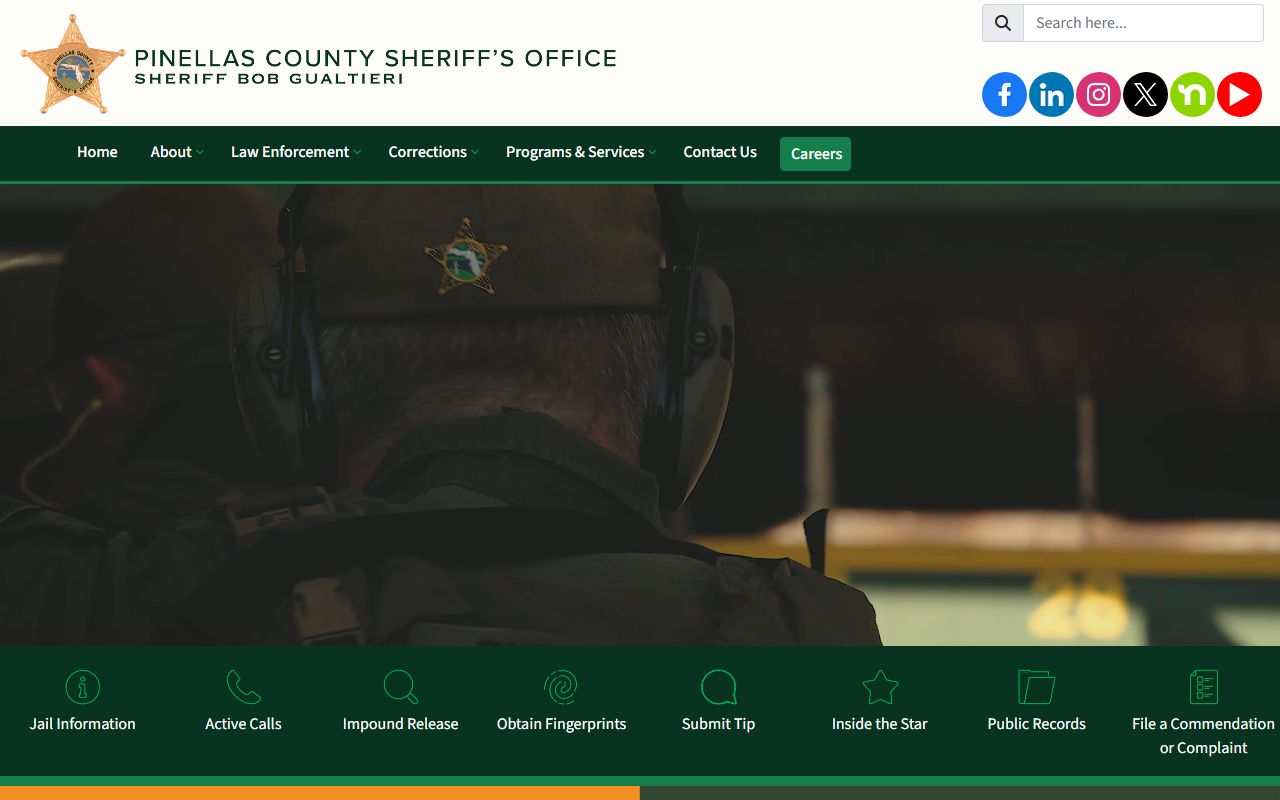
The PCSO homepage links to the inmate inquiry, visitation, inmate information, warrants, and agency news. It is the starting point for any custody-related question about the Pinellas County Jail.
For full details on the inmate roster, booking search fields, sample record fields, visitation hours, and mail and money procedures, see the Pinellas County inmate records page. For active warrants, see Pinellas County warrant records. For recently released inmates, see released inmates. For jail population data and trends, see Pinellas County inmate population.
Marriage, Divorce, and Pinellas Probate Records
Marriage licenses in Pinellas County are issued by the Clerk of the Circuit Court and Comptroller at the Clearwater Courthouse and St. Petersburg Judicial Building. Florida residents who complete a qualifying premarital preparation course pay a lower fee and have the three-day waiting period waived. After the ceremony, the signed license is returned to the Clerk for recording in Official Records. Certified copies of recorded marriage licenses can be ordered through the Official Records portal or Clerk copy services. Divorce is a Circuit Court family division matter filed with the Clerk. The petition for dissolution of marriage carries a filing fee plus a separate charge for recording and reporting the final judgment. For full details on both processes, see Pinellas County marriage and divorce records.
Probate is handled by the Probate and Guardianship Division of the Circuit Court at Clearwater Courthouse Room 106, phone (727) 464-3321, email probate@mypinellasclerk.gov. This division also handles guardianship, incapacity proceedings, Baker Act commitments, Marchman Act petitions, advance health care directives, elder exploitation issues, and tuberculosis quarantine matters. Modern probate case documents require registered user access for online viewing. A historical Probate Inquiry for records from 1973 to 1987 is available as a separate index link on the Clerk's View Records page. For filing fees and procedures, see Pinellas probate records.
- Testator
- The person who made a will; the decedent whose estate enters probate.
- Personal Representative
- The person appointed by the court to administer a probate estate (called executor or executrix in some states, but Florida uses personal representative).
- Guardian
- A person appointed by the court to make decisions for an incapacitated adult or a minor when a court order establishes guardianship.
- Intestate
- Dying without a valid will; the estate is distributed under Florida's default laws of intestate succession.
- Letters of Administration
- A court document issued to the personal representative authorizing them to act on behalf of the estate.
Pinellas County Court Records Fees
The Clerk fee schedule covers copy costs, search fees, filing charges, certification, and special services. Most online viewing through Court Records Public View and the Official Records portal is free. Fees apply when Clerk staff perform a search, when you order copies, or when you request certification. The table below shows common copy and search fees from the current published schedule.
| Item | Amount |
|---|---|
| Record search by Clerk staff (initial name) | $7.00 per name |
| Each additional year where record found | $2.00 per year |
| Copying court or official records, per page | $1.00 per page |
| Copying public records, one-sided page | $0.15 per page |
| Copying public records, two-sided page | $0.20 per page |
| Certification of copies | $2.00 |
| Exemplified certificate | $7.00 |
| Authenticated certificate | $7.00 |
| Sealing or expungement filing | $42.00 plus copy/certification/notary/mailing |
| Marriage license (FL residents, premarital course) | $61.00 |
| Marriage license (nonresident or without course) | $86.00 |
| Petition for dissolution of marriage | $397.50 plus $10.50 recording/reporting final judgment |
| Formal probate/guardianship filing | $400.00 |
The fee schedule page, shown below, provides the full list including traffic, tax deed, recording, and passport-related charges.
Visit the Clerk fee schedule page
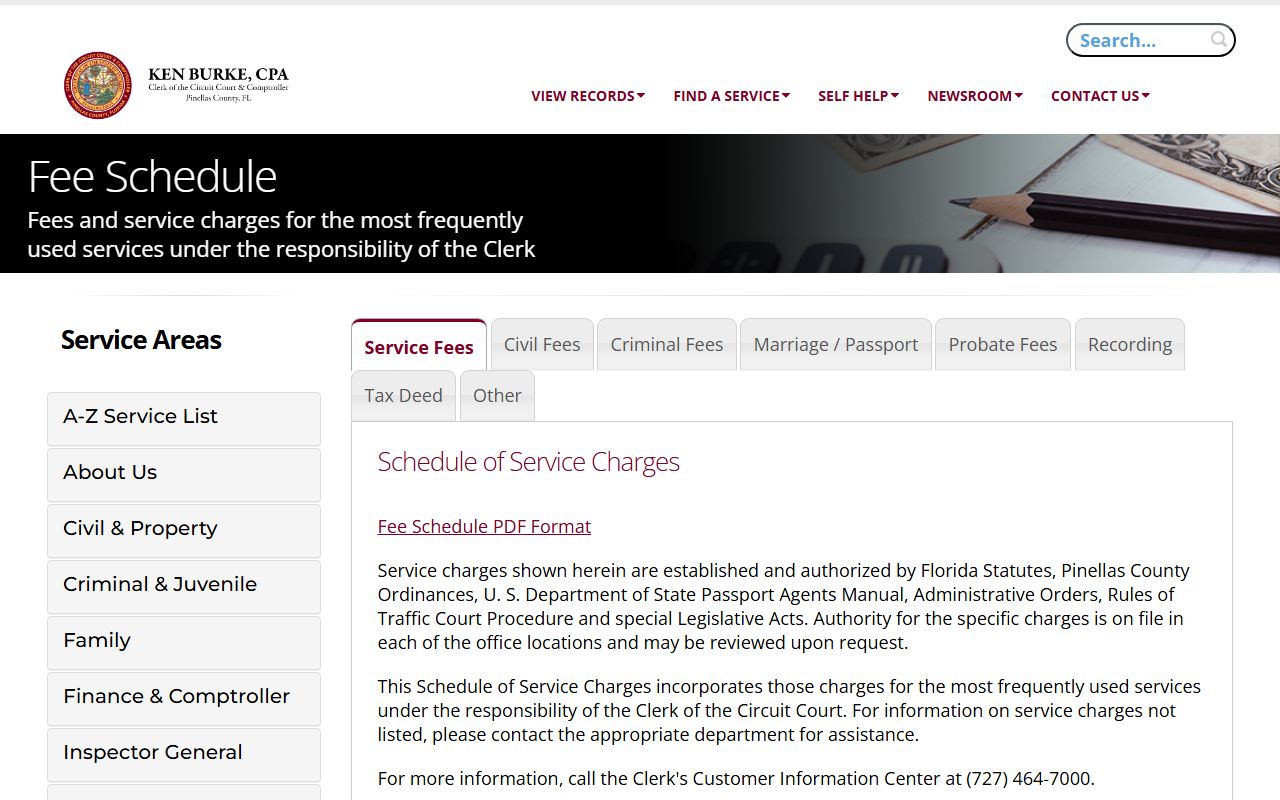
The fee schedule is the official source for all Clerk charges. Fees shown here are from the published schedule; confirm current amounts before submitting payment because the Clerk may update the schedule.
How to Interpret Pinellas County Court Records
Court records use legal terms and abbreviations that can be confusing if you are not familiar with them. A case number suffix tells you the court type: CF is a felony, MM is a misdemeanor, CC is county civil, CA is circuit civil, DP is dependency, DR is domestic relations/family, and GA is probate/guardianship. A docket entry of "NOL PROS" or "nolle prosequi" means the prosecutor decided not to pursue that charge. It does not mean the arrest was wrong; it means the charge was not pursued to a finding of guilt or innocence. Arrest records and conviction records are different things. A booking record shows a person was arrested and booked; it says nothing about whether they were charged, tried, convicted, or acquitted.
The following legal terms appear frequently in Pinellas court records.
- Plaintiff
- The party who starts a civil lawsuit by filing a complaint.
- Defendant
- The party sued in civil court or charged in criminal court.
- Docket
- The chronological log of court activity on a case, showing every filing, hearing, and order.
- Disposition
- The final or current outcome of a charge or case, such as guilty, dismissed, nolle prosequi, or default judgment.
- Capias
- A court order commanding an arrest, often issued after a failure to appear at a scheduled hearing.
- Nolle Prosequi
- The prosecutor's formal decision not to pursue a charge; the case is dropped but may not be expunged without a court order.
- Probation
- Court-ordered supervision in the community instead of or in addition to jail or prison time.
- Bond
- A financial condition for release from custody; the bond assessed field in the PCSO charge report shows the amount set, and bond amount due shows what remains unpaid.
- Expunction
- A legal process to remove eligible criminal history records from most public access and require agencies to destroy covered records.
- Sealing
- A legal process to make eligible criminal history confidential but not destroy it; a sealed record is not visible to the general public but is retained by agencies.
The PCSO arrest inquiry includes an arrest type field that tells you why someone is in custody: "On View" means a direct arrest at the scene; "Adult Warrant" or "Traffic Warrant" means arrest on a pre-existing warrant; "948.06-VOP" means a probation violation; "Federal Marshal" means a federal hold; "Off Bond" means bond was revoked. Knowing the arrest type helps distinguish active warrants from new charges and from probation-related returns to custody.
Accuracy and Record Limitations
Court and jail records are not always current or complete at the moment of an online search. The Pinellas Clerk's docket updates as the Clerk receives and processes filings, but there is no guarantee of real-time updates. The PCSO arrest inquiry warns that booking information may not reflect State Attorney charging decisions or trial outcomes and that an acquittal or dismissal does not necessarily negate the validity of an arrest. For current custody status, use the official Sheriff portal. For final case disposition, use the Clerk court records portal. For statewide criminal history, use FDLE. For state prison and supervision records, use the Florida Department of Corrections search. For federal custody, use the BOP inmate locator. Each is a separate custodian with separate data.
Some documents may not appear online for several reasons: the case predates electronic scanning, the document contains sensitive information awaiting redaction, the case type restricts remote access (family, probate, juvenile), or the record is available only on courthouse terminals. If a document is missing from the online view, do not assume it does not exist. Visit a public terminal or submit a copy request through the Clerk request center.
Note: Always confirm custody status, case dispositions, and hearing dates directly with the originating government office before taking any action based on online records.
Self-Help and Legal Aid Resources in Pinellas County
Several organizations provide legal assistance to Pinellas residents who cannot afford a private attorney or who want help navigating the court system. The Clerk's Legal Self Help Centers offer attorney consultations for a minimum of $15 for family law, small claims, and landlord-tenant matters. Appointments are available in person at Clearwater Courthouse Room 114, St. Petersburg Judicial Building Room 103, and the North County Customer Information and Service Center. Telephonic appointments are available on request. These centers help with forms and court procedures but cannot give legal advice on strategy.
The Sixth Judicial Circuit self-represented litigant page provides forms, administrative orders, family law materials, and virtual hearing guidance. Self-represented parties must follow the same rules as attorneys, including service of process, filing deadlines, and hearing procedures.
- Community Law Program - Free civil legal services for financially eligible Pinellas residents; services include family law, housing, probate, and criminal records expunction. Located at 501 First Ave N, Room 519, St. Petersburg, FL 33701; phone (727) 582-7480.
- Gulfcoast Legal Services - Free legal help in housing stability, family law and domestic violence, immigration, financial stability, elder law, public benefits, birth certificate and ID project, and a low-income taxpayer clinic.
- Bay Area Legal Services - Free civil legal help for eligible residents in Pinellas, Hillsborough, Pasco, Manatee, and Sarasota counties, and seniors and veterans statewide.
- Public Defender Sara Mollo - Appointed defense for criminal defendants who cannot afford private counsel; more than 200 staff and over 100 attorneys serving Pinellas and Pasco counties.
Note: Legal aid organizations have income and case-type eligibility requirements. Contact each organization directly to confirm eligibility before expecting representation.
History of Pinellas County Courts
Pinellas County was created in 1912, separating from Hillsborough County, with Clearwater as the county seat. The county quickly needed permanent civic buildings. By 1916, county commissioners approved a bond issue for a permanent courthouse and jail. The Old Pinellas County Courthouse was designed by architect Francis J. Kennard and built in the late 1910s, with additions in 1924 and 1926. It was added to the National Register of Historic Places in 1992. Today it stands at 324 South Fort Harrison Avenue in Clearwater as the Clearwater Historic Courthouse and remains listed by the Sixth Judicial Circuit, though routine court and Clerk functions have moved to the modern buildings nearby. Users should not travel to the historic courthouse expecting to file papers or pick up records; the active Clerk and court service locations are the modern Clearwater Courthouse and Justice Center.
Florida's modern two-tier trial court structure dates to the Article V judicial reorganization, which unified and restructured the state's courts. Pinellas grew into a high-volume urban circuit. The Sixth Circuit now includes 69 judges and five facilities across Pinellas and Pasco counties. High-profile litigation has drawn national attention to Pinellas courts over the decades, most notably the end-of-life proceedings before retired Circuit Judge George Greer involving Terri Schiavo in the early 2000s. Court modernization has since added remote electronic record access, E-Notify court-event reminders, electronic filing, video visitation at the jail, and online copy request workflows. Pinellas court pages should be described as an electronic-access layer on top of older paper and microfilm records, some of which predate current scanning programs.
Federal Court Records for Pinellas County
Federal court cases involving Pinellas County parties are not in the Clerk's state court portal. Federal cases are filed and searched through the U.S. District Court for the Middle District of Florida, Tampa Division, which serves Pinellas, Hillsborough, Pasco, Polk, Manatee, Hardee, and Sarasota counties. The federal courthouse is the Sam M. Gibbons United States Courthouse, 801 North Florida Avenue, Tampa, FL 33602. The federal clerk's office phone is (813) 301-5400, and clerk hours are 8:30 a.m. to 4:00 p.m., Monday through Friday, except federal holidays. Visitors must present valid official photo ID.
Federal court handles federal criminal cases, civil rights cases under federal law, federal-question civil suits, diversity jurisdiction civil cases, and appeals from federal bankruptcy court. Federal bankruptcy cases in Pinellas are handled by the U.S. Bankruptcy Court for the Middle District of Florida. Federal case dockets and documents are accessed through PACER for the Middle District of Florida, not through the Pinellas Clerk. The U.S. Attorney's Office for the Middle District of Florida handles federal prosecutions. Appeals from Middle District of Florida decisions go to the U.S. Court of Appeals for the Eleventh Circuit.
For Pinellas County court records at the state level, use the Clerk's portal. For federal records, use PACER. The two systems do not share data or search interfaces.
Frequently Asked Questions
How do I search Pinellas County court records?
Start at the Clerk View Records page and choose Court Records Public View for no-login access to most criminal, civil, and traffic case records. Search by case number if you have it, or by party name if not. Family and probate documents require a registered user login for online viewing. Juvenile records are not available online and must be requested in person at the Justice Center with valid photo ID.
Is the Pinellas court records search free?
Searching is free through Court Records Public View and the Official Records portal. Fees apply when Clerk staff perform a name search ($7.00 per name, $2.00 per additional year a record is found), when you order copies ($1.00 per page for court or official records), and when you need certification ($2.00 per document). Viewing a docket entry online does not cost anything. Printing or certifying it does.
What is the difference between Court Records and Official Records?
Court Records are case files and dockets for lawsuits, criminal cases, traffic tickets, family cases, and probate proceedings. Official Records are recorded instruments such as deeds, mortgages, liens, marriage licenses, plats, affidavits, and powers of attorney. Some court judgments are also recorded into Official Records as lien instruments. Use the court records portal for cases and the Official Records portal for recorded documents. Sending a case-docket request to the Official Records system will return no result.
Who is the Pinellas County Clerk?
Ken Burke, CPA, is the elected Clerk of the Circuit Court and Comptroller of Pinellas County. He was first sworn in on January 4, 2005, and was re-elected without opposition in 2008, 2012, 2016, 2020, and 2024. His office manages approximately $43 million in budget and employs around 550 people. The Clerk's full title is Clerk of the Circuit Court and Comptroller, reflecting both the judicial records and county financial responsibilities of the office.
What court handles felonies in Pinellas?
Felony cases are handled in Circuit Criminal Court of the Sixth Judicial Circuit, typically with proceedings and records at the Pinellas County Justice Center at 14250 49th Street North, Clearwater. Misdemeanor cases without a concurrent felony are in County Criminal Court. A case number ending in CF is a felony; MM is a misdemeanor. Contact the Clerk at (727) 464-7000 for criminal records questions.
How do I find someone in the Pinellas County Jail?
Use the Sheriff arrest inquiry ("Who's in Jail") at the PCSO website. It covers current inmates and people released within the last 30 days. You can search by name, docket number, booking date, race, sex, arresting agency, charge type, or arrest type. For releases older than 30 days, submit a records request through the PCSO records request portal. The jail phone is (727) 464-6415.
More answers on the Pinellas County Court Records FAQ page.