
Florida Public Records Law and Pinellas County
Florida's public-records framework rests on two pillars. The first is the Florida Statutes Chapter 119 public records act, which defines what a public record is, who must produce it, what fees apply, and what exemptions exist. The second is the Florida Constitution, Article I, Section 24, which gives every person the constitutional right to inspect or copy public records and to attend public meetings. That constitutional guarantee applies to all three branches of state and local government. Pinellas County's own public records page states the general rule: everyone has the right to obtain public records unless the Legislature has created an exemption or the record is otherwise made confidential by law.
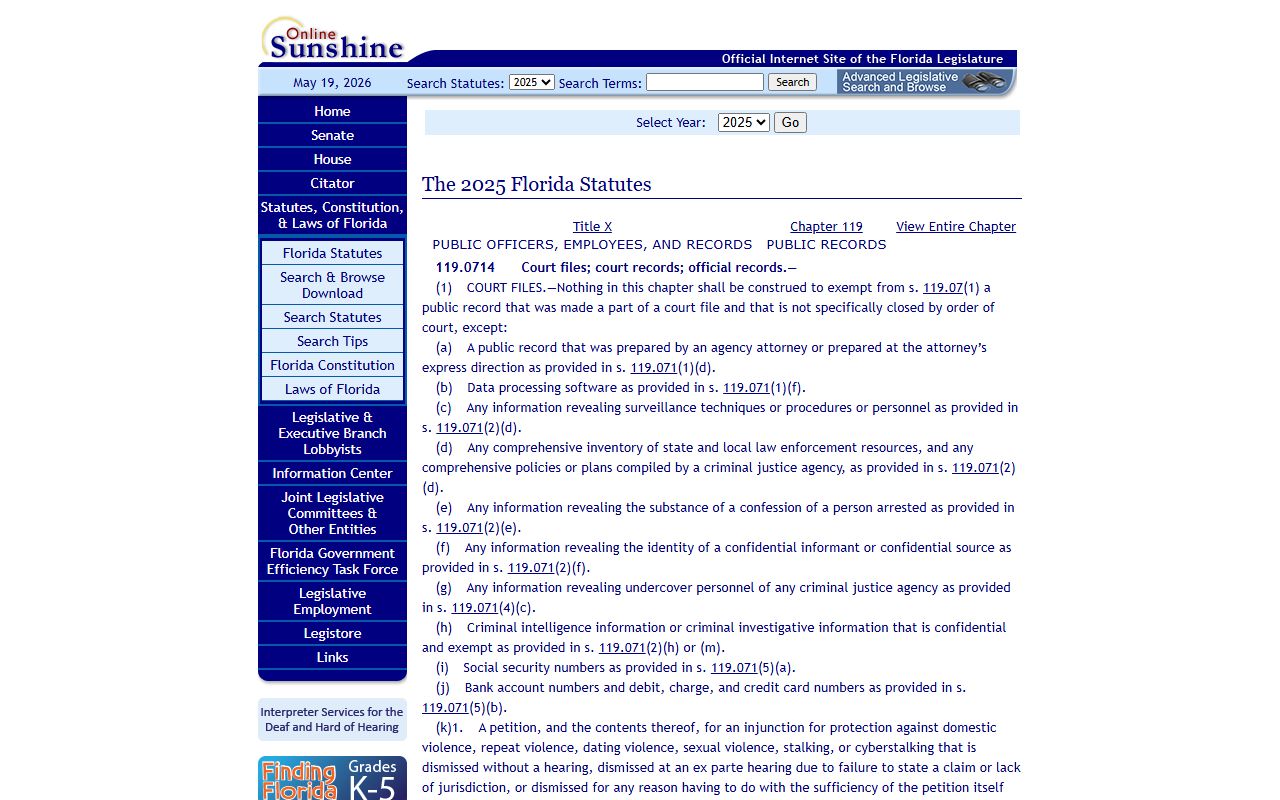
For court records specifically, the framework adds one more layer. Florida Statutes §119.0714 addresses court files, court records, and official records exemptions. It is the main statutory authority behind redaction requests and the Clerk's rules on displaying sensitive identifiers. Florida Rule of General Practice and Judicial Administration 2.420 governs judicial branch records in detail. It defines court records, administrative records, confidential information, the role of the Clerk as custodian, motions to determine confidentiality, and how remote electronic access must be managed under Florida Supreme Court standards. Together, Chapter 119 and Rule 2.420 explain why some court documents are visible to anyone online, some require registered login, some are available only at courthouse terminals, and some are fully confidential.
The practical rule under §119.07 is the redact-and-produce standard. If a record contains both public and exempt information, the custodian must separate the exempt portion, redact it, and produce the rest. The custodian cannot withhold the whole record just because part of it is exempt. If the agency refuses to produce any part of a record, it must state the specific statutory basis for the exemption. Fees are governed by the same statute: copying charges must be limited to the actual cost of duplication, and special service charges apply only when the nature or volume of the request requires extensive use of technology or clerical or supervisory assistance beyond the norm.
Florida courts apply these rules consistently. An agency that refuses a lawful request without citing a valid exemption may face an enforcement action under §119.12, which authorizes attorney fees against the agency when a court finds the agency unlawfully withheld records after proper notice. That threat gives practical weight to the constitutional right of access and encourages agencies to err toward disclosure rather than suppression.
The Florida Supreme Court's court-structure page provides context for understanding which court records go through which custodian. Knowing the difference between a circuit court case, a county court case, an official recorded instrument, and an agency administrative record helps you direct your request to the right office the first time.
Florida's court structure is described on the Florida Supreme Court website, which is the authoritative source for the state court system overview.
Pinellas County Public Records by Custodian
A key point that trips up many people: Pinellas County government and the Pinellas County Clerk of the Circuit Court and Comptroller are separate custodians. So are the Sheriff, the Property Appraiser, the Tax Collector, and the Supervisor of Elections. Florida's independent constitutional officers each maintain their own records and must be contacted directly. Pinellas County's public records page explicitly notes that some agencies listed are separate from county government and requests must go to those agencies directly. Sending a request to the wrong office will not start the clock on the statutory response deadline.
The Clerk of the Circuit Court and Comptroller, Ken Burke, CPA, is the most comprehensive single records custodian in Pinellas County for court and official records. The Clerk maintains custody of court records for Circuit Court and County Court, collects and disburses court-ordered fines and child support, records instruments in the Official Records, issues marriage licenses, handles probate and guardianship records, provides traffic and parking payment services, and manages copy and certification requests. No other local office holds all of those record types under one roof.
The Clerk's record categories fall into two main portals. The Court Records Public View portal covers case dockets and documents for criminal, civil, and traffic matters. The Official Records portal covers recorded instruments such as deeds, mortgages, liens, judgments, plats, powers of attorney, affidavits, and marriage licenses. These are separate systems, and confusing them is one of the most common search mistakes. A deed is not in the court records system; a felony case docket is not in the official records system. Some court judgments cross over when they are recorded as liens, but the two portals each have their own search fields and result formats.
The records the Clerk maintains include:
- Circuit Court criminal, civil, family, probate, and guardianship case files and dockets
- County Court misdemeanor, civil, small claims, landlord-tenant, and traffic case files
- Official Records: deeds, mortgages, liens, judgments recorded as liens, plats, marriage licenses, powers of attorney, affidavits, and tax deed instruments
- Marriage licenses issued at Clearwater Courthouse and St. Petersburg Judicial Building
- Probate court records at Clearwater Courthouse Room 106
- Traffic, parking, and ordinance payment records
- Board of County Commissioners records and county financial records in the Clerk's comptroller role
The Pinellas County Sheriff's Office under Sheriff Bob Gualtieri is a separate custodian for arrest and booking records, jail-related records, warrant information, and PCSO agency records. Requests for booking data, older arrest records not visible in the public inquiry, incident reports, and similar law enforcement documents go to PCSO, not to the Clerk. County departments such as planning, public works, and health and human services maintain their own administrative records through Pinellas County government's public records process.
The Pinellas County public records page at pinellas.gov lists county offices and links to agency request channels. Use it as a directory when the record you need is not a court file or a Sheriff record.
The Chapter 119 public records index on the Florida Legislature's site covers the full text of the public records act, including all subsections on definitions, exemptions, enforcement, and fees.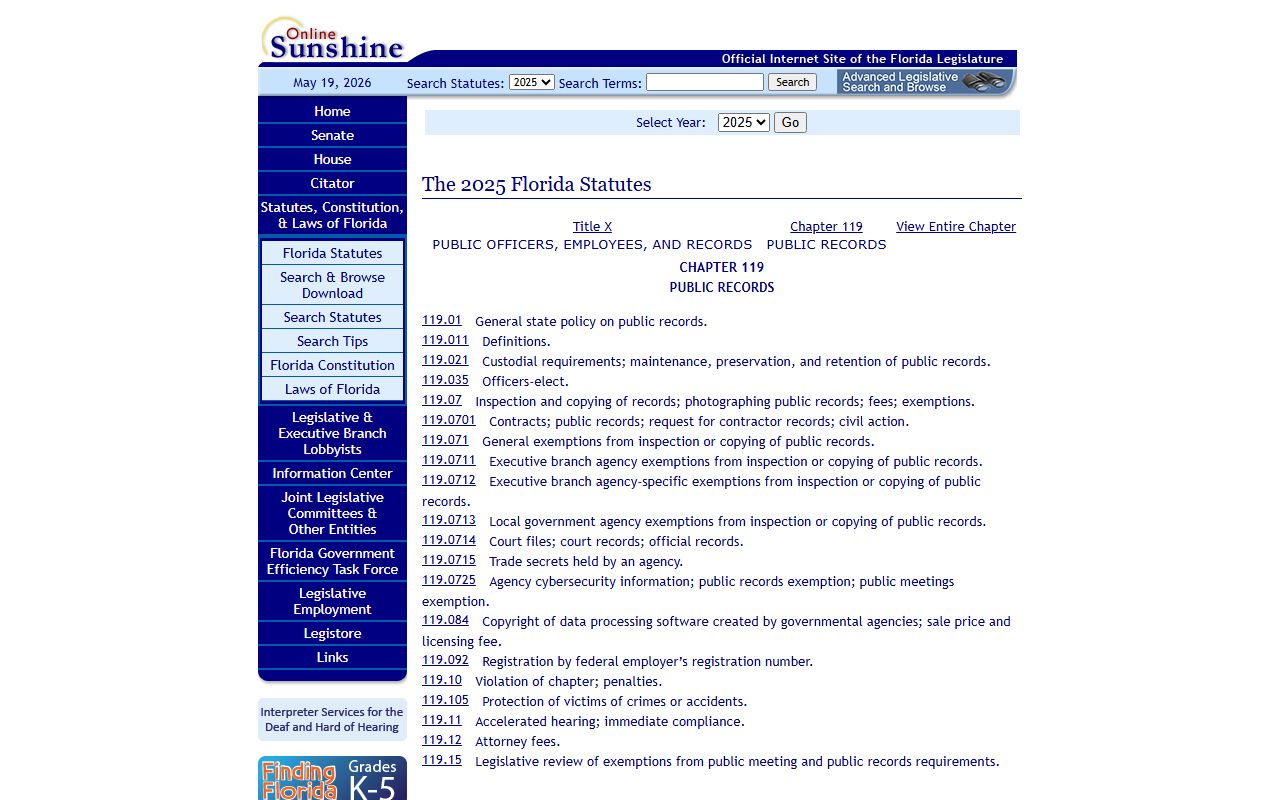
How to File a Pinellas County Public Records Request
Florida does not require a written request form or a stated reason for a public records request. You can ask orally, by email, by mail, or through an online portal. That said, a written request creates a clear record of what you asked for and when. For Pinellas County government records and Clerk copy requests that cannot be filled through the online portals, the primary channel is the Pinellas public records request center (GovQA). The Clerk quotes the cost by email after reviewing the request, and you pay before the records are released. Start by checking whether the record is available for free through the public portals before submitting a formal request.
- Identify the correct custodian. Decide whether the record is a court case file (Clerk court records portal), an official recorded instrument (Clerk official records portal), a law enforcement or booking record (PCSO), or a county administrative document (Pinellas County government). Sending to the wrong office delays the process. Check the Pinellas County public records page and the Clerk's site to confirm which office holds what you need.
- Check the free public portals first. Many criminal, civil, and traffic court records are free through the Clerk's Court Records Public View at courtrecords.mypinellasclerk.gov. Official Records such as deeds and liens are searchable at officialrecords.mypinellasclerk.gov at no cost. If the record appears and can be printed or saved from the portal, you may not need to file a formal request at all.
- Describe the record precisely. Florida law does not require you to state why you want the record, but the clearer your description, the faster the agency can locate it. Include names, approximate dates, case numbers if known, record type (court case, deed, arrest report, marriage license), and the format you prefer (paper copy, electronic, certified). For court records, include the case number in the format the Clerk uses, such as 25-01828-CF-1 for a criminal case.
- Submit through the right channel. For Clerk records not available online, use the GovQA portal at pinellascountyfl.govqa.us, call the Clerk at (727) 464-7000, or visit the correct Clerk office. Civil and family records are at Clearwater Courthouse; criminal records are at the Pinellas County Justice Center. For PCSO records, use the PCSO records request portal. For county government records, use the Pinellas County public records page.
- Wait for a cost estimate. The Clerk contacts requesters with a fee quote by email when copying, certification, or research staff time is involved. Florida law does not set a fixed response deadline in hours, but agencies must respond within a reasonable time. Complex or large requests may take longer. If you have not heard back in a few business days, follow up with the Clerk or the agency contact.
- Pay the fee and receive the records. Fees for copies and certification are fixed by law and the Clerk fee schedule. Pay the quoted amount, and the Clerk will provide the records by mail, email, or in-person pickup depending on the format and your preference. If the agency denies the request in whole or in part, it must state the specific exemption basis. You have the right to challenge an unlawful denial.
- If denied, escalate properly. A denial without a valid statutory exemption can be challenged. You may contact the Florida Attorney General's office for guidance, or file a civil action in circuit court. Under §119.12, a court may award attorney fees if the agency unlawfully refused access after proper notice. Escalation to litigation should generally follow an attempt to resolve the dispute directly with the agency first.
Note: the Clerk's record search fee of $7.00 per name applies when Clerk staff physically search records on your behalf. Searching the public portals yourself does not trigger that charge.
The full text of §119.07 of the Florida Statutes sets out the inspection and copying rules, including the redact-and-produce standard and the requirement that custodians state the specific exemption basis when withholding records.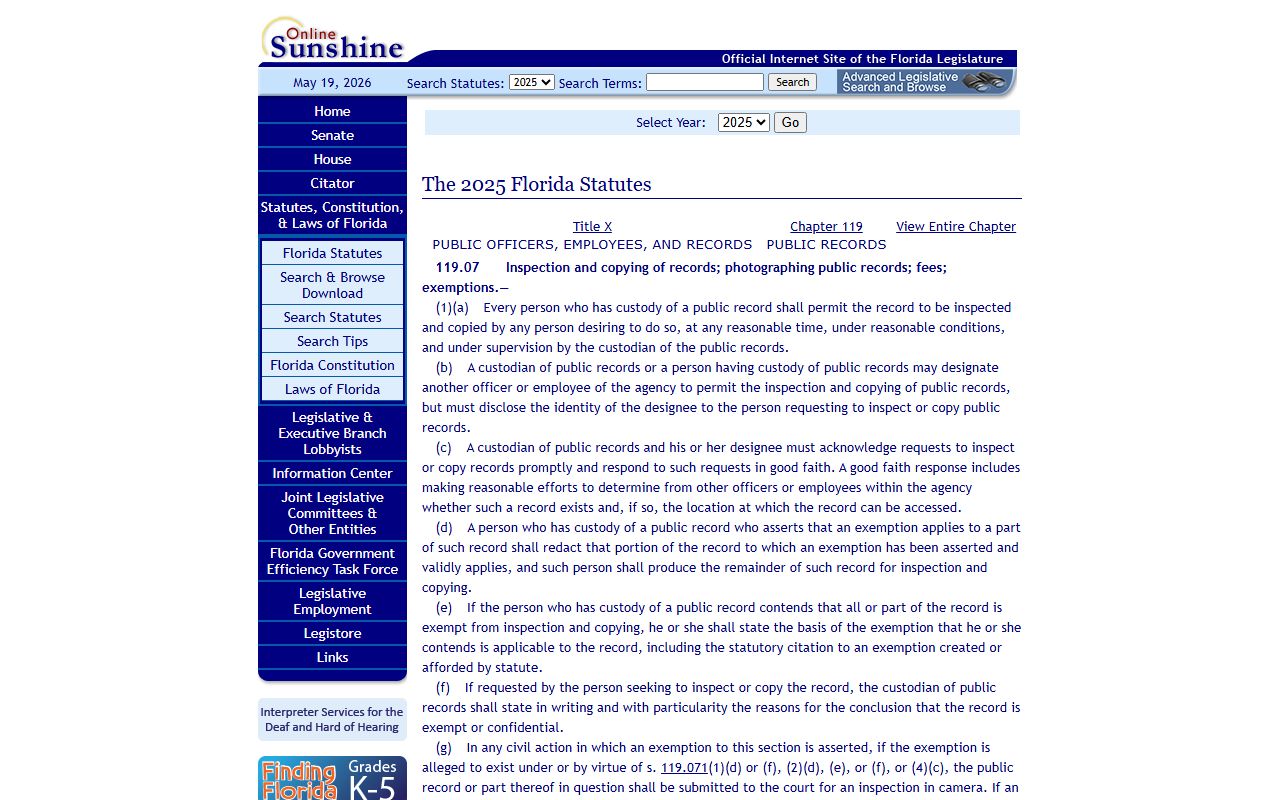
Pinellas Public Records Request Form Fields
The GovQA portal used by Pinellas County and the Clerk does not require a reason for the request, but it collects enough information to route the request to the right staff member and send you a cost quote. The fields below reflect what the portal and Clerk process typically require. Even if you submit by phone or in person rather than through the web portal, having this information ready speeds up the process.
| Field Label | Required | Notes |
|---|---|---|
| Name / Alias to be searched | Yes (for name-based searches) | Full legal name. Clerk states name and alias are needed for record searches. |
| Maiden name | If applicable | Used to broaden the search where name has changed. |
| Date of birth | Yes (for name-based searches) | Helps distinguish persons with the same or similar name. |
| Last 4 digits of Social Security Number | Optional if available | Requested to narrow results; not required if unavailable. |
| Requester contact information | Yes (in GovQA portal) | Portal sends cost quote and response by email; valid email address required. |
| Record type / description | Yes | Describe the record: court case file, official recorded instrument, certified copy, arrest report, or general search. Include case number if known. |
| Date range | If applicable | Narrows the search and can reduce fees. Approximate year is often sufficient when an exact date is unknown. |
| Format preference | Optional | Paper copy, electronic, certified, exemplified. Certified copies carry an additional fee per the Clerk fee schedule. |
| Payment | Required if fees apply | Clerk contacts requester with quoted amount before releasing records. Fees are governed by Chapter 119 and the Clerk fee schedule. |
Public Records Fees in Pinellas County
Florida law limits what agencies can charge for public records. Standard copy fees are set by statute. When a request is large enough to require extensive staff time or technology resources beyond the ordinary, an agency may add a special service charge based on the actual labor cost of the highest-paid employee who could fulfill the request. The Pinellas Clerk's published fee schedule provides the specific rates that apply to court and official records. The table below reflects fees from the Clerk fee schedule for the categories most relevant to public records requests.
| Item | Amount |
|---|---|
| Copying public records, one-sided page | $0.15 |
| Copying public records, two-sided page | $0.20 |
| Copying court records or official records, standard page | $1.00 per page |
| Certifying copies | $2.00 |
| Exemplified certificate | $7.00 |
| Authenticated certificate | $7.00 |
| Record search by Clerk staff, initial search | $7.00 per name |
| Each year where an offense or record is found | $2.00 |
| Sealing or expungement filing fee | $42.00 plus copy, certification, notary, and mailing charges as applicable |
| Electronic database copy under Chapter 119 | Varies; quoted after review |
A few points about fees that cause confusion. The $7.00 per-name search fee applies when Clerk staff physically search records on your behalf. It does not apply when you search the public court records portal or official records portal yourself online. Those free online searches are not a "record search" in the fee-schedule sense. The per-page copying charge for court and official records is $1.00, which is higher than the $0.15 / $0.20 Chapter 119 copying rate for general public records. This reflects the statutory rate for court file copies, not a surcharge the Clerk invented. Certification adds $2.00 on top of the copy charge per document. If you need an exemplified copy, such as for use in another state's proceeding, the exemplification certificate adds $7.00. Agencies that charge more than the statutory rate or add fees not authorized by Chapter 119 violate the public records law.
For county agency records outside the court system, the standard Chapter 119 rate of $0.15 per one-sided page and $0.20 per two-sided page applies. Electronic records may be provided at actual cost, which can be less than paper copy fees if the record already exists in digital form. If the agency charges for staff time on a large or unusual request, it must use the labor cost of the lowest-paid employee capable of performing the task, unless higher-paid supervision was genuinely required.
Exempt and Confidential Pinellas County Records
Florida's public records law has hundreds of specific exemptions scattered through the Florida Statutes. These are not agency discretion; they are statutory carve-outs. If an exemption exists, the custodian must cite it when withholding. If no exemption exists, the record must be produced. The Pinellas Clerk's system reflects the most common exemptions that affect court and official records.
Social Security numbers, bank account numbers, credit card numbers, charge account numbers, and debit account numbers can be redacted from court and official records on request under §119.0714 and related rules. Florida Rule 2.425 goes further for court filings: it requires filers to minimize how much sensitive data enters the court file in the first place, rather than relying entirely on after-the-fact redaction. The Clerk's system may show sensitive financial data blacked out or may delay availability of a document until redaction is complete. If you receive a record with redactions, the agency should have identified the statutory basis; if it did not, you can ask.
Categories of records that are restricted or confidential in Pinellas County include:
- Juvenile delinquency and dependency records, which are not available online through the Clerk and may require in-person access by the juvenile defendant with valid identification
- Adoption records, which are sealed by statute under §63.162 except as a court order or specific statute allows
- Mental health clinical records, including Baker Act and Marchman Act proceedings, under §394.4615
- Sealed and expunged criminal history, which are removed from public court view by court order under §943.059 and §943.0585 respectively
- Victim identifying information, including protected address information for victims of domestic violence and other specified offenses
- Military discharge records and death certificates in Official Records, which require subscriber access under Clerk rules
- Records subject to court-ordered confidentiality, gag orders, or specific judicial branch confidentiality rulings under Rule 2.420
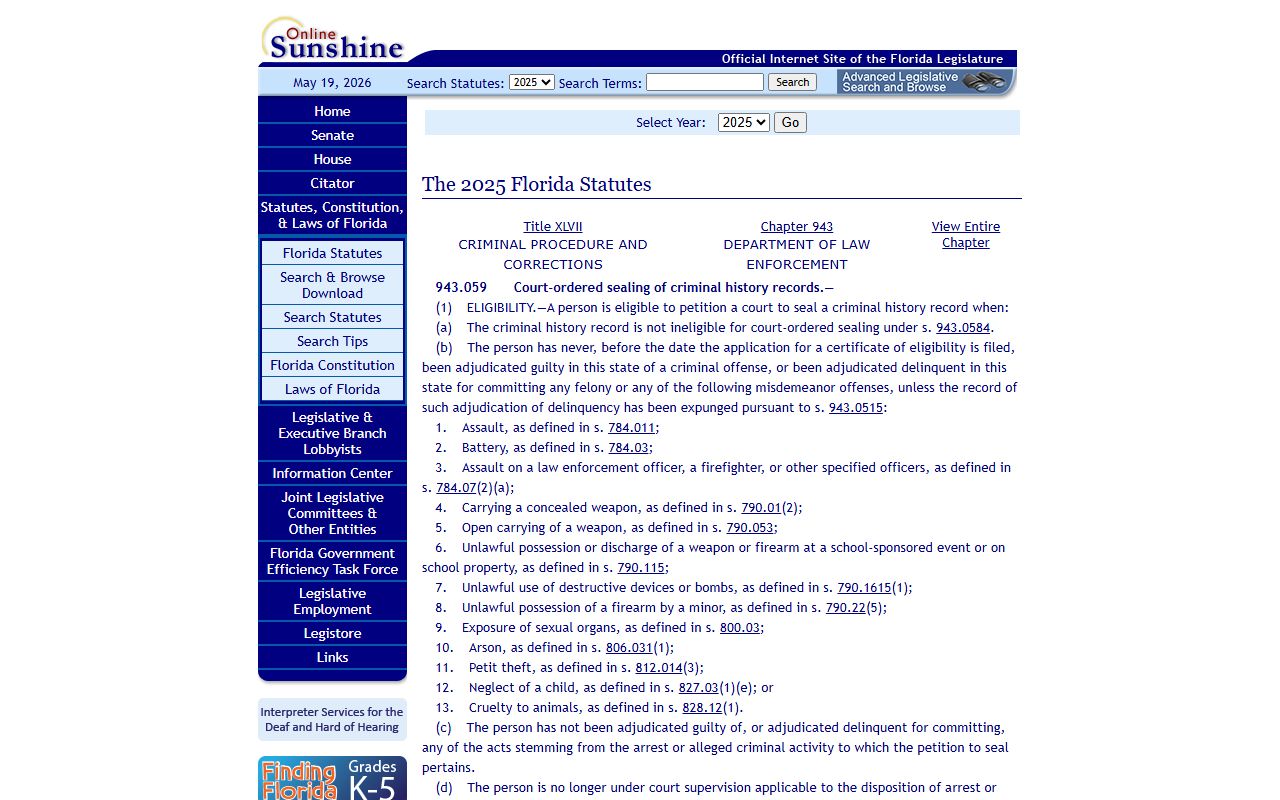
The sealing and expunction process involves two separate statutes. Sealing under §943.059 makes eligible criminal history confidential without destroying it. Expunction under §943.0585 goes further and requires physical destruction or removal of the eligible records from ordinary public access, subject to statutory exceptions for certain agencies. Both require FDLE eligibility review and a court order before the Clerk can act.
The Florida Statutes §943.0585 expunction page on the Legislature's site contains the full court-ordered expunction statute, including eligibility requirements, agency duties, and exceptions.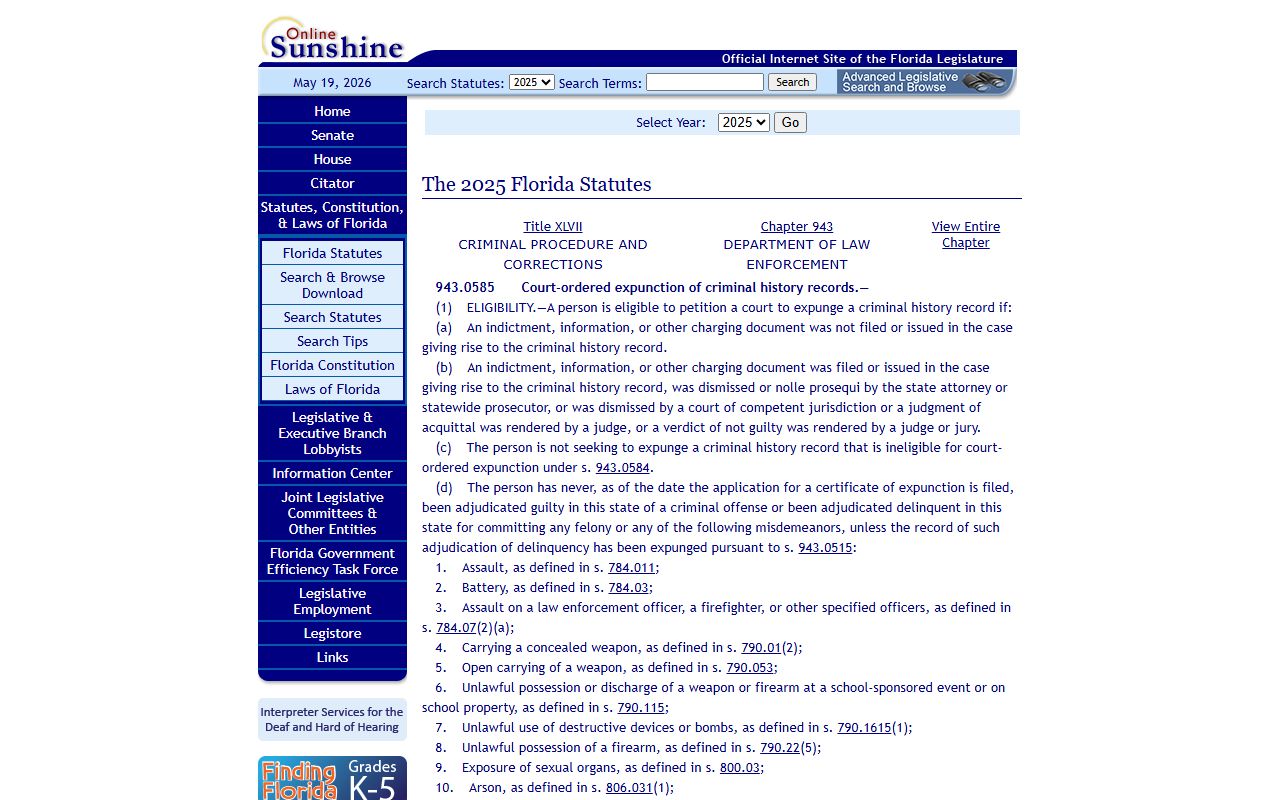
For sealing, the §943.059 sealing statute is the parallel provision that makes eligible records confidential rather than destroyed. The Clerk's process for both sealing and expunction involves FDLE eligibility review, a $75 cashier's check or money order to FDLE, and a Clerk filing fee of $42 plus applicable copy, certification, notary, and mailing charges. The State Attorney has an opportunity to respond, and the judge decides whether to enter the order.
Pinellas County Official Records: Deeds, Liens, and Judgments
Official Records are a distinct record category from court case files. They are instruments recorded with the Clerk under Chapter 28 and related recording statutes. Recording gives legal notice to the world that a document exists. Deeds, mortgages, liens, judgments, plats, powers of attorney, affidavits, declarations, marriage licenses, and tax deed instruments are all recorded in Official Records. A court judgment, for example, may appear in the court case docket and also be separately recorded as a lien in Official Records. They are not the same entry, and they are searched in different portals.
The Clerk's Official Records portal at officialrecords.mypinellasclerk.gov provides several search paths. You can search by name (grantor or grantee), instrument number, document type, record date, book and page, case number, legal description, or a simple guided search. The portal warns users to search spelling variations because some surnames have spaces or alternate formatting that can cause a name to appear differently in the index. The portal also requires users to accept a disclaimer before proceeding; it does not warrant the accuracy of results and recommends confirming important facts with the recording office directly.
Official Records access is free to search. Document images may require a viewer in PDF or TIFF format. Some older records, military discharges, and death certificates in Official Records require subscriber access online and may need in-person or staff-assisted access. If you need a certified copy of a deed, lien, or recorded instrument for legal proceedings, the Clerk charges $1.00 per page for the copy plus $2.00 for certification. Exemplified copies carry an additional $7.00 exemplification fee.
Recording services and Official Records are handled at Clearwater Courthouse, Room 150. The Clerk's Recording Services page describes recordable instrument types, the recording process, and related services including fraud alerts for property owners who want to monitor their property records for unauthorized filings.
Court Records vs Agency Public Records in Pinellas County
The distinction between court records and agency public records matters because the rules are not identical. Court records held by the Clerk are governed by both Chapter 119 and Florida Rule 2.420. Agency records held by county departments or independent constitutional officers are governed primarily by Chapter 119. When a record is a judicial branch record, Rule 2.420 controls and the Clerk acts as the judicial records custodian rather than simply a Chapter 119 custodian. This is why the Clerk's public access model has anonymous, registered, and attorney access tiers that Chapter 119 alone does not require.
Court records in Pinellas County are divided into public, registered-access, and confidential categories under Rule 2.420 and related Florida Supreme Court standards. Many criminal, civil, and traffic case records and documents are available without any login through the Court Records Public View portal. Family and probate case documents require a registered user account according to the Clerk's FAQ. Juvenile records are not available online at all. Some documents are held back until redaction of sensitive financial identifiers is complete. Older records may not yet be scanned and require in-person inspection at public view terminals at Clearwater Courthouse, the Pinellas County Justice Center, the St. Petersburg Judicial Building, or the North County branch.
County agency records through Pinellas County government follow a simpler Chapter 119 framework: request, produce or cite exemption, charge the statutory copy rate. The Pinellas County public records page identifies the county's public records policy, lists the public records liaison, and provides links to the GovQA request portal for county departments. Note that the page distinguishes between county government records and records held by independent constitutional offices; clicking through to the correct office is the requester's responsibility.
For criminal background purposes, note that the Clerk does not provide statewide or national criminal history checks. Statewide criminal history is maintained by the Florida Department of Law Enforcement. National criminal history is the FBI's domain. The Clerk can search its own court records by name and provide what it finds in Pinellas court cases, but that is different from a comprehensive background check.
Note: the Clerk's $7.00 per-name record search fee applies to staff-assisted searches. Searching the court records portal or official records portal yourself at a public terminal or online is free of that charge.Response Times and Enforcement in Pinellas County
Florida law does not set a fixed number of days for responding to a public records request. The standard is "reasonable time," which courts have interpreted based on the nature and complexity of the request, the volume of records involved, and the agency's resources. A request for a single document that is immediately available online should be fulfilled quickly. A request for thousands of records covering many years may take considerably longer. Most straightforward Clerk copy requests in Pinellas are processed within a few business days once the requester has been quoted a fee and paid.
If a request is unusually large, the Clerk or agency may ask for additional identifying information or an advance deposit before beginning a lengthy search. This is permitted as long as the fees charged are within statutory limits and the agency does not use the fee process to delay or obstruct access. If a request is denied in whole or in part, the agency must state the specific statutory exemption it is relying on. A denial that simply says "confidential" without citing a statute number is not a valid response under Chapter 119.
If you believe an agency has unlawfully denied or delayed your request, the first step is usually to contact the agency's public records coordinator or legal department and point out the specific record you requested and the statutory provision you believe requires disclosure. If that fails, the Florida Attorney General's office publishes guidance on public records enforcement, though the Attorney General does not have direct enforcement power over local agencies. The ultimate remedy is a civil action in circuit court under §119.11 and §119.12. Courts have ordered agencies to produce records and awarded attorney fees when the denial was willful and without legal basis.