
How to Look Up Pinellas County Jail Population Data
The official source for Pinellas County jail population data is the Public Safety Coordinating Council indicator report series. These reports are produced by Pinellas County and draw on figures from the PCSO Jail Custody Management Division. The most recent report available at the time of this research is the Q2 2025 corrected indicators report, published at pinellas.gov. An earlier 4th-quarter 2024 report is also available at pinellas.gov and provides the September 2024 status breakdown by custody category.
Each PSCC indicator report presents the jail average daily population (ADP) for the current period alongside prior-year comparisons. The Q2 2025 corrected report shows the 2025 year-to-date ADP through March as 2,926, up 1.5 percent from June 2024 and up 26.2 percent from June 2020. The 4Q 2024 report breaks September 2024 ADP by custody status, showing pretrial felons, pretrial misdemeanors, county sentenced felons, county sentenced misdemeanors, state Department of Corrections holds, and other categories. These reports do not update in real time. They are quarterly publications, so figures reflect the period covered by each report rather than a live daily count. For current custody of a specific person, use the PCSO arrest inquiry search tool or call the jail at (727) 464-6415.
The PSCC indicator reports are the most reliable published source for Pinellas-specific ADP data. Other data points, such as national jail occupancy trends, come from the Bureau of Justice Statistics (BJS) and the Vera Institute of Justice, which compile state and national incarceration data annually. When reviewing any jail population figure for Pinellas, note whether the source is the county-specific PSCC report or a broader state/national estimate.
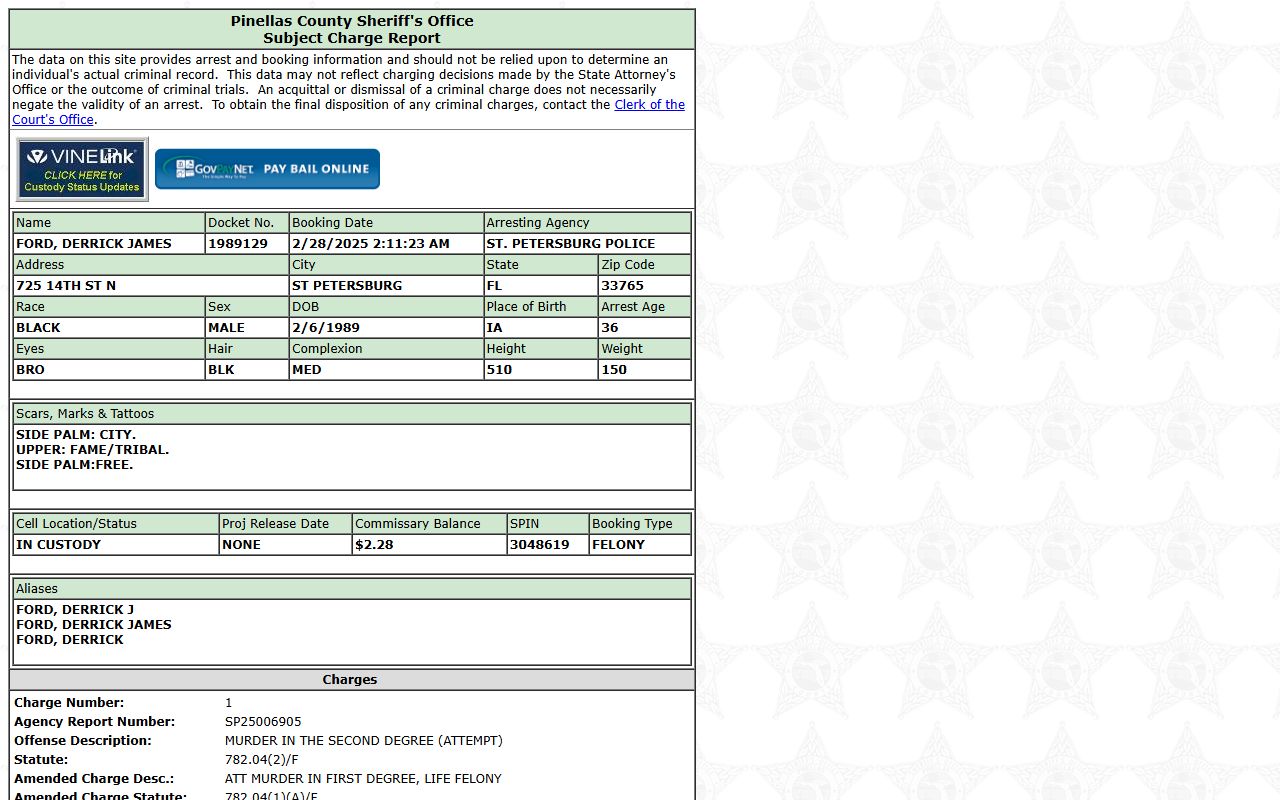
The PCSO Subject Charge Report shows booking details for individual inmates and is one way to understand the types of charges driving population at any given time. The report is an individual record, not a population summary, but it illustrates the fields that feed into aggregate counts: custody status, booking type, charge category, bond amount, and court case number.
Pinellas County Jail Capacity Overview
The Pinellas County Jail complex is located at 14400 49th Street North, Clearwater, FL 33762-2877, and consists of multiple buildings on the same site. The complex holds felony defendants, misdemeanor defendants, sentenced inmates, and specialty populations including medical and mental health cases. The 2025 inmate handbook notes that various housing divisions serve different classifications of inmates and detainees.
The official total rated capacity for the full jail complex was not located in the PCSO pages reviewed for this research. PCSO does not publish a single consolidated bed count for the entire complex on its public website. Third-party capacity figures conflict and are not used here. The one official capacity figure that PCSO does publish is for its dedicated healthcare facility: 432 beds. That facility opened in 2007 and occupies 165,200 square feet within the jail complex.
| Facility | Rated Capacity | Notes |
|---|---|---|
| Pinellas County Jail Complex | Not published by PCSO | Multiple buildings; total bed count not confirmed in official sources |
| Jail Healthcare Facility | 432 beds | Opened 2007; 165,200 sq ft; NCCHC-accredited medical and mental health unit |
Note: official total capacity for the full Pinellas County Jail Complex is not available in current PCSO public documents. Use the ADP reports as the most reliable official measure of current population levels.
The healthcare facility is a major component of the jail's infrastructure. It includes x-ray equipment, dialysis services, dental chairs, 20 negative-pressure isolation cells, a mental health clinic, a trauma clinic, attorney visitation booths, a video courtroom, and monitoring and security systems. PCSO describes its jail as a Triple Accredited Agency for corrections, correctional health care, and law enforcement, including 2024 ACA reaccreditation after auditors visited May 29 to 31, 2024.
Average Daily Population in Pinellas County Jail
The average daily population (ADP) is the standard measure for jail occupancy. It counts the average number of people held in the jail on any given day over a set period. For Pinellas County, the PSCC indicator reports are the primary published ADP source, drawing on PCSO Jail Custody Management Division data.
The 2024 annual ADP for the Pinellas County Jail was 3,070. That figure marks a return toward pre-COVID levels after a sharp drop in 2020. The 2025 year-to-date average through March, as reported in the Q2 2025 corrected report, was 2,926. The June 2025 report notes that the most recent period was up 1.5 percent from June 2024, up 26.2 percent from June 2020, up 6.4 percent from June 2015, and down 2.2 percent from June 2009. These comparisons show the jail population has largely recovered from the 2020 reduction and sits above its 2015 level.
ADP reflects not just arrests but also bond practices, pretrial release decisions, case processing speed, probation violations, sentenced jail terms, state DOC transfers, federal holds, and specialty court or diversion activity. A rise in ADP does not necessarily mean more crime; it can also reflect changes in bond or pretrial release policies. The PSCC reports are the right place to track Pinellas-specific ADP over time.
Demographic Breakdown of Pinellas County Inmates
The PSCC indicator reports provide ADP broken out by custody status category, including pretrial felons, pretrial misdemeanors, county sentenced felons, county sentenced misdemeanors, state DOC holds, and other categories. The reports do not publish a separate gender/race/age demographic table in the sections reviewed for this research. General county demographic context is available through U.S. Census data.
The Census QuickFacts for Pinellas County estimate the July 1, 2025 county population at 948,563, while the 2020 Census counted 959,107 residents. Pinellas County has 273.8 square miles of land, making it one of Florida's more densely populated counties. Census data for the county provides overall demographic context but does not reflect the jail population specifically. Jail populations typically differ from county-wide demographics in age distribution, gender, and other characteristics.
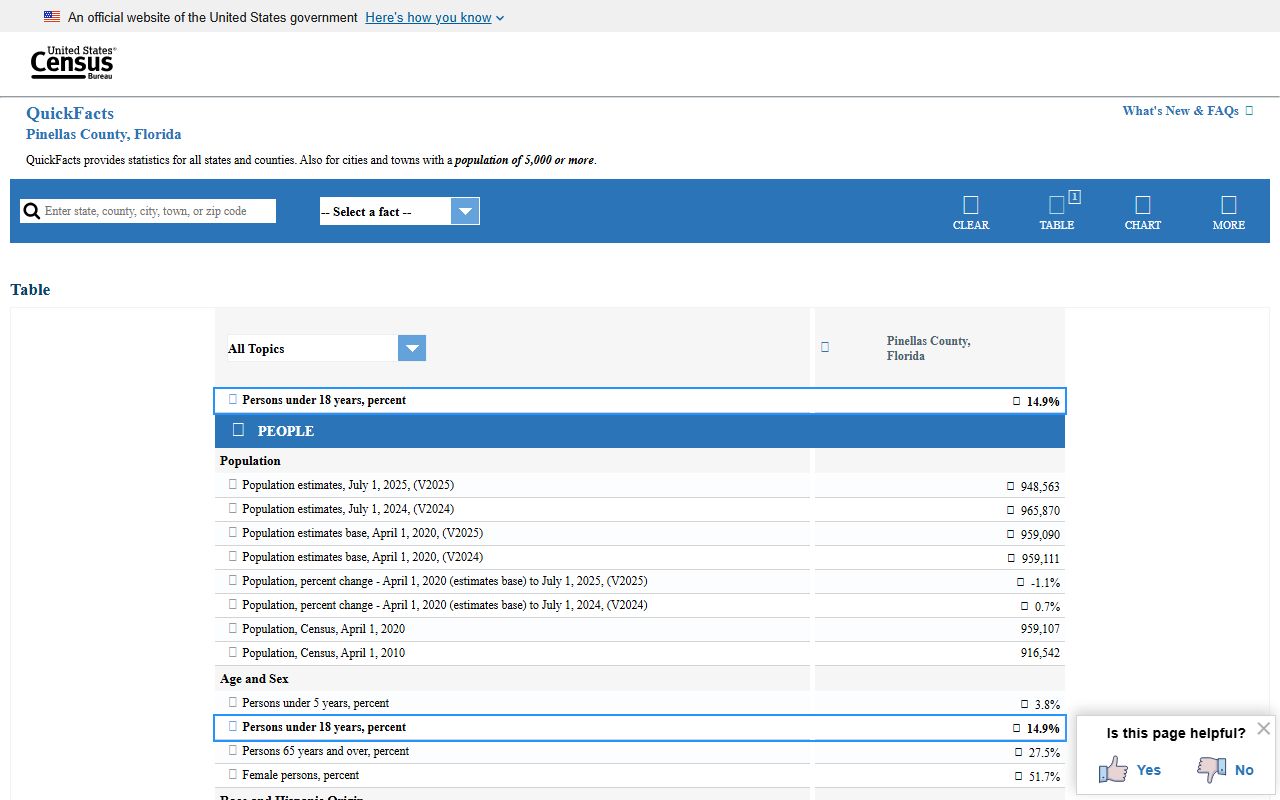
The Census detailed profile for Pinellas County provides additional demographic and economic background. For jail-specific demographic breakdowns, the PSCC indicator reports and PCSO annual reports are the appropriate primary sources. If the county publishes a more detailed demographic breakdown in a future report, those figures would supersede the custody-status categories currently available.
Pretrial vs. Sentenced Population in Pinellas County
The most detailed status breakdown in current Pinellas jail data comes from the 4Q 2024 PSCC indicators report. It shows September 2024 ADP by custody category. The single largest group in the Pinellas County Jail is pretrial felons, accounting for 60 percent of the population. That figure means most people in the jail at any given time have not been convicted of the charges that led to their current booking. They are waiting for their case to move through the court system, which can include arraignment, pretrial hearings, plea negotiations, and trial.
| Custody Status (September 2024) | Share of ADP |
|---|---|
| Pretrial Felons | 60% |
| Pretrial Misdemeanors | 12% |
| County Sentenced Felons | 10% |
| County Sentenced Misdemeanors | 5% |
| State DOC (sentenced to state prison) | 2% |
| Other | 11% |
These are Pinellas County-specific figures from the 4Q 2024 PSCC report. Combined, pretrial inmates (felony and misdemeanor) account for 72 percent of the September 2024 population. Sentenced county inmates make up 15 percent. The state DOC category covers people already sentenced to state prison who remain in the county jail pending transfer to a state facility. The "Other" category can include federal holds, immigration-related holds, civil commitments, and similar classifications. The 4Q 2024 report also contains monthly category counts for 2022 through 2024, showing that pretrial felons have consistently been the dominant driver of jail population throughout that period.
A high pretrial share does not mean every pretrial inmate is at risk of conviction. Many will be acquitted, have charges reduced or dropped, or resolve their cases without a jail sentence. Bond eligibility, pretrial release programs, and case processing speed all affect how long a pretrial inmate stays in the jail before their case concludes. The Pinellas Clerk maintains the court records that track case outcomes; the jail booking records reflect custody status, not final disposition.
Misdemeanor vs. Felony Population in Pinellas County
The September 2024 PSCC data makes the felony/misdemeanor split clear. Pretrial felons (60 percent) and county sentenced felons (10 percent) together account for 70 percent of the jail population. Pretrial misdemeanors (12 percent) and county sentenced misdemeanors (5 percent) together account for 17 percent. This means felony-related inmates outnumber misdemeanor inmates by roughly four to one in the Pinellas County Jail.
Florida law routes felonies to the Sixth Judicial Circuit Court while misdemeanors without a concurrent felony go to County Court. Felony cases generally take longer to resolve than misdemeanor cases, which helps explain why the pretrial felony share is so large. A person charged with a felony may remain pretrial in the jail for many months while their case is prepared, plea-negotiated, or tried. Misdemeanor cases tend to move faster, so the pretrial misdemeanor population stays smaller even though misdemeanor arrests make up a significant share of total bookings.
The jail does not separately publish a breakdown of specific charge types driving felony population. The PCSO arrest inquiry allows the public to filter bookings by charge category, which gives a real-time view of the most common charges on any given day. As of the research period, the charge dropdown on the PCSO inquiry page includes categories ranging from battery and burglary to DUI, failure to appear, murder, probation violation, and traffic warrant. Probation violations, for example, show up as a distinct arrest type (948.06-VOP) and contribute to both felony and misdemeanor population without a new substantive offense.
Mental Health and Medical Population in Pinellas County Jail
The Pinellas County Jail operates a dedicated 432-bed healthcare facility within the jail complex. PCSO describes it as providing healthcare for all inmates, staffed by licensed and certified personnel following National Commission on Correctional Health Care (NCCHC) standards. The facility includes a mental health clinic, a trauma clinic, x-ray equipment, dialysis services, dental chairs, and 20 negative-pressure isolation cells. This level of on-site medical infrastructure is substantial and reflects the range of health needs in a jail that routinely holds close to or above 3,000 people.
The PSCC indicator reports do not break out a specific percentage of the jail population receiving mental health or medical care. However, the scale of the healthcare facility, 432 beds in a 165,200-square-foot building, indicates a significant medical and mental health caseload. The jail's PREA reporting channel and the Safe Harbor reentry program both reflect awareness that inmates may arrive with complex needs beyond secure custody.
Mental health referrals in the Pinellas criminal justice system often intersect with the Sixth Judicial Circuit's Probate and Guardianship Division, which handles Baker Act and Marchman Act proceedings for involuntary mental health treatment and substance abuse intervention. A person held under a Baker Act examination or a Marchman Act order may pass through the jail or a related facility as part of the process, though Baker Act civil holds are distinct from criminal charges. The Safe Harbor program at the Pinellas County Jail also serves as a jail diversion and reentry portal for people experiencing homelessness, many of whom have co-occurring mental health and substance use challenges.
National and State Context for Pinellas County Jail Population
National jail incarceration data is compiled by the Bureau of Justice Statistics, a division of the U.S. Department of Justice. BJS publishes an annual Census of Jails and Jail Inmates reports that track average daily population, rated capacity, and incarceration rates per 100,000 residents across jurisdictions. The Vera Institute of Justice also publishes state and county-level incarceration trend data through its Incarceration Trends project, which draws on BJS data.
As of the most recent available BJS data, the national jail incarceration rate was approximately 220 per 100,000 residents. Florida's rate tracked near the national average in recent years, though county-level variation is significant. For Pinellas County, using the 2024 ADP of 3,070 and the Census-estimated county population of approximately 948,563, the implied Pinellas County jail incarceration rate is roughly 324 per 100,000 residents. That figure is higher than the national average and reflects the county's high pretrial share and the absence of a large pretrial release alternative program that would divert the pretrial felony population.
| Level | Approximate Jail Population per 100,000 | Source / Notes |
|---|---|---|
| Pinellas County (2024) | ~324 | PSCC indicator report ADP 3,070 / Census population ~948,563 |
| Florida (recent) | ~220-250 (estimated) | BJS / Vera state-level data; varies by year and county mix |
| National (recent) | ~220 | Bureau of Justice Statistics Census of Jails |
These are estimates based on the most recent available data and should be read as approximations rather than precise current counts. BJS rates are based on midyear survey data and may not line up exactly with annual ADP. The Pinellas figure uses a population estimate that itself changes year over year. The rate comparison is useful for understanding where Pinellas County sits relative to state and national trends, not as a definitive ranking. Florida's rate varies widely across its 67 counties because county policies, demographics, and pretrial practices differ substantially.
Population Trends Over Time in Pinellas County Jail
The PSCC indicator reports document a clear multi-year trend for the Pinellas County Jail. Population dropped sharply in 2020, likely due to reduced court activity, expanded emergency pretrial release, and lower arrest activity during the COVID-19 pandemic. Beginning in 2021, ADP rose steadily as courts resumed normal operations, pretrial release policies reverted toward pre-pandemic norms, and arrest activity increased. By 2024, ADP had reached 3,070, which is the highest annual figure in the range covered by the PSCC reports reviewed here.
| Year | Annual Average Daily Population (Pinellas County Jail) |
|---|---|
| 2020 | 2,476 |
| 2021 | 2,748 |
| 2022 | 2,885 |
| 2023 | 2,886 |
| 2024 | 3,070 |
| 2025 YTD (through March, per Q2 report) | 2,926 |
These figures are from the Pinellas County PSCC indicator reports and are county-specific. The 2025 year-to-date figure of 2,926 is slightly below the 2024 full-year average, which may reflect seasonal variation, court activity patterns, or policy changes early in the year. The Q2 2025 corrected report notes the most recent period ADP was up 1.5 percent from June 2024 on a year-over-year basis, suggesting the lower early-year figure did not continue into the summer months.
Between 2022 and 2023, ADP held nearly flat, rising just one inmate from 2,885 to 2,886. Then in 2024 it jumped by 184. The drivers behind that increase are not detailed in the PSCC reports themselves, but operational factors such as a rise in pretrial felony filings, bond policy changes, or reduced diversion program capacity could all contribute. The PSCC indicator reports track category counts monthly from 2022 through 2024, giving researchers a more granular picture than annual averages alone.
For context, the Q2 2025 report also references a June 2009 ADP level that was 2.2 percent above the most recent period. That suggests the 2025 jail population is close to but slightly below levels from more than fifteen years ago, even though the county population has changed in the interim. The 2015 figure was 6.4 percent below the current level, placing 2024 to 2025 levels above the mid-decade low point.
Jail diversion programs affect how many people enter the population in the first place. Safe Harbor, specialty court programs, and pretrial release alternatives all reduce the number of people who remain in custody during case processing. The Sixth Judicial Circuit operates an Adult Drug Court, juvenile diversion programs, and other alternatives to standard pretrial detention. As those programs expand or contract, the ADP trend line moves accordingly. The long-term trend data in the PSCC reports is the best available tool for tracking how those programs affect the Pinellas County Jail population over time.
Searching for Pinellas County Inmate Records by Name
The figures discussed in the sections above cover aggregate Pinellas County jail population data and trends. For name-based searches of the live jail roster, individual booking records, and charge information for specific people, use the Pinellas County inmate records page, which covers the PCSO arrest inquiry tool and how to search by name, docket number, booking date, or charge.
Where the Pinellas County Jail Population Data Comes From
The primary sources for Pinellas County jail population data are the county's Public Safety Coordinating Council indicator reports. These are official Pinellas County documents produced with data from the PCSO Jail Custody Management Division. The Q2 2025 corrected report and the 4Q 2024 report are cited directly. Both are publicly accessible documents at pinellas.gov. These reports are the appropriate citation for Pinellas-specific ADP and custody status figures.
National and state context figures come from the Bureau of Justice Statistics, which publishes jail census and inmate count data annually, and from the Vera Institute of Justice, which produces the Incarceration Trends data tool. BJS data covers all U.S. jails and provides the national average incarceration rate. Vera data allows county-level comparisons over time, though the most recent Vera data may not match the current year's PSCC figures exactly because of publication timing differences.
The PCSO official page at pinellassheriff.gov is the source for the healthcare facility specifics: 432 beds, 165,200 square feet, opened 2007, NCCHC accreditation, and facility features. The 2025 Pinellas County Jail inmate handbook provides additional operational context on classification, fees, and programming. Census data used for population denominators comes from the U.S. Census Bureau QuickFacts and profile pages for Pinellas County, Florida.
Figures marked as Pinellas County-specific are drawn from PSCC reports or PCSO official pages. Figures marked as state or national are from BJS or Vera and may not align exactly with Pinellas data from the same period. The research gap on total jail capacity is noted above: no official PCSO source inspected published a total rated bed count for the full complex, so that figure is not included here.