
Pinellas County Circuit Court Overview
Florida has two tiers of trial courts: circuit courts and county courts. Circuit courts are the courts of general jurisdiction, meaning they hear cases that are not limited by a monetary cap or restricted to a narrow class of offenses. In Pinellas County, the Circuit Court handles felony criminal cases, civil disputes above the county-court monetary threshold, family law matters including divorce and custody, probate and guardianship proceedings, juvenile delinquency and dependency cases, and mental health matters such as Baker Act and Marchman Act proceedings. It also handles certain appeals from County Court. The Florida Supreme Court describes circuit courts as the trial courts of general jurisdiction within Florida's unified court structure, which includes four court levels: the Supreme Court, the District Courts of Appeal, the Circuit Courts, and the County Courts.
The circuit court in Pinellas has five facilities spread across the county, reflecting both the population size and the geographic reach of the county from Tarpon Springs in the north down to South St. Petersburg. Civil, probate, and family matters are primarily handled at the Clearwater Courthouse in downtown Clearwater. Criminal court operations for felony and circuit criminal cases are based at the Pinellas County Justice Center on 49th Street North. South County users have access to some services at the St. Petersburg Judicial Building, and a North County branch serves residents in communities like Palm Harbor, Dunedin, Safety Harbor, and Oldsmar. Each facility carries specific divisions, and court users should verify the correct location before arriving.
The Sixth Judicial Circuit's About the Circuit page confirms the Pinellas court's scale and local significance, including its status as Florida's third-largest trial court system.
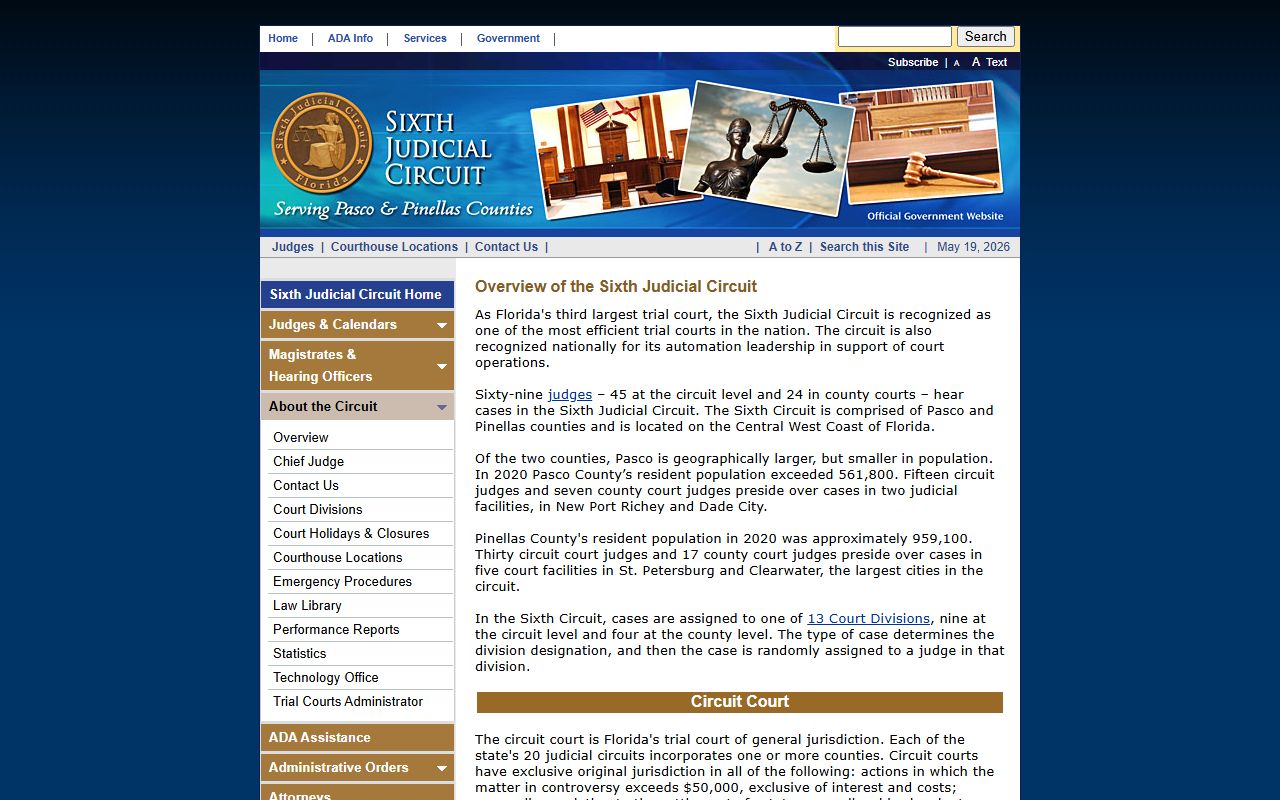
The About the Circuit page provides the official overview of the Sixth Judicial Circuit's structure and jurisdiction, including Pinellas and Pasco county operations.
The Sixth Judicial Circuit in Pinellas County
Pinellas County is part of the Sixth Judicial Circuit, which also includes Pasco County to the north. The Sixth Circuit is one of Florida's 20 judicial circuits and identifies itself as the state's third-largest trial court. Across both counties, the circuit has 69 judges: 45 circuit judges and 24 county judges. Pinellas County alone has 30 circuit court judges and 17 county court judges operating across its five court facilities. The circuit assigns incoming cases to divisions by case type and then randomly assigns each case to a judge within the appropriate division. This random-assignment model is designed to avoid judge-shopping and distribute caseloads evenly.
The circuit's administrative functions, including the assignment of judges to specialty sections, community violence court, and unified family court, are governed by administrative orders issued by the Chief Judge. In Pinellas, a 2025 judicial assignment order identified specific sections for community violence court covering dating, domestic, repeat, and sexual violence injunction hearings, Jimmy Ryce civil commitment cases, and probate specialty sections for Marchman Act proceedings, risk protection orders, and firearm disability matters. These assignments show that the Sixth Circuit in Pinellas is a high-volume court with specialized case routing well beyond a standard civil-criminal split.
Note: Pasco County has its own courthouse facilities within the Sixth Judicial Circuit but is a separate county. Case filings for Pinellas County matters go to Pinellas facilities, not Pasco.
Pinellas Circuit Court Divisions and Facilities
The Pinellas County Circuit Court operates through several divisions, each handling a defined category of cases. The divisions are not all located in the same building. A circuit civil case filed in Pinellas will follow a different path through the court's facilities than a felony criminal case or a family dissolution matter. The table below identifies the main circuit-level divisions and the courthouse facilities where their operations are concentrated.
| Division / Court Type | Jurisdiction | Primary Facility | Contact |
|---|---|---|---|
| Circuit Civil | Civil cases over $50,000; auto negligence, malpractice, foreclosure, real property, eminent domain, contracts, condominium, Jimmy Ryce proceedings | Clearwater Courthouse, 315 Court Street, Clearwater, FL 33756 | (727) 464-7000 |
| Circuit Criminal | Felonies and misdemeanors arising from same circumstances as a felony | Pinellas County Justice Center, 14250 49th Street North, Clearwater, FL 33762 | (727) 464-7000 |
| Family Division | Divorce, child support, parental responsibility, time-sharing, adoption, paternity, name change, injunctions, juvenile matters | Clearwater Courthouse / St. Petersburg Judicial Building | (727) 464-7000 |
| Probate and Guardianship | Estates, wills, trusts, guardianship, incapacity, Baker Act, Marchman Act, advance directives, elder exploitation, tuberculosis quarantine | Clearwater Courthouse, Room 106 | (727) 464-3321 |
| Unified Family Court | Coordinates multiple family cases involving the same family before one judge; includes juvenile delinquency, dependency, adoptions, termination of parental rights | Pinellas Family Division locations | (727) 464-7000 |
| Community Violence Court | Dating, domestic, repeat, and sexual violence injunction hearings; risk protection orders; firearm disability | Assigned Pinellas section per administrative order | (727) 464-7000 |
The Sixth Circuit Court Divisions page provides the official description of each division's jurisdiction and the types of matters handled across circuit and county courts in the Sixth Judicial Circuit.
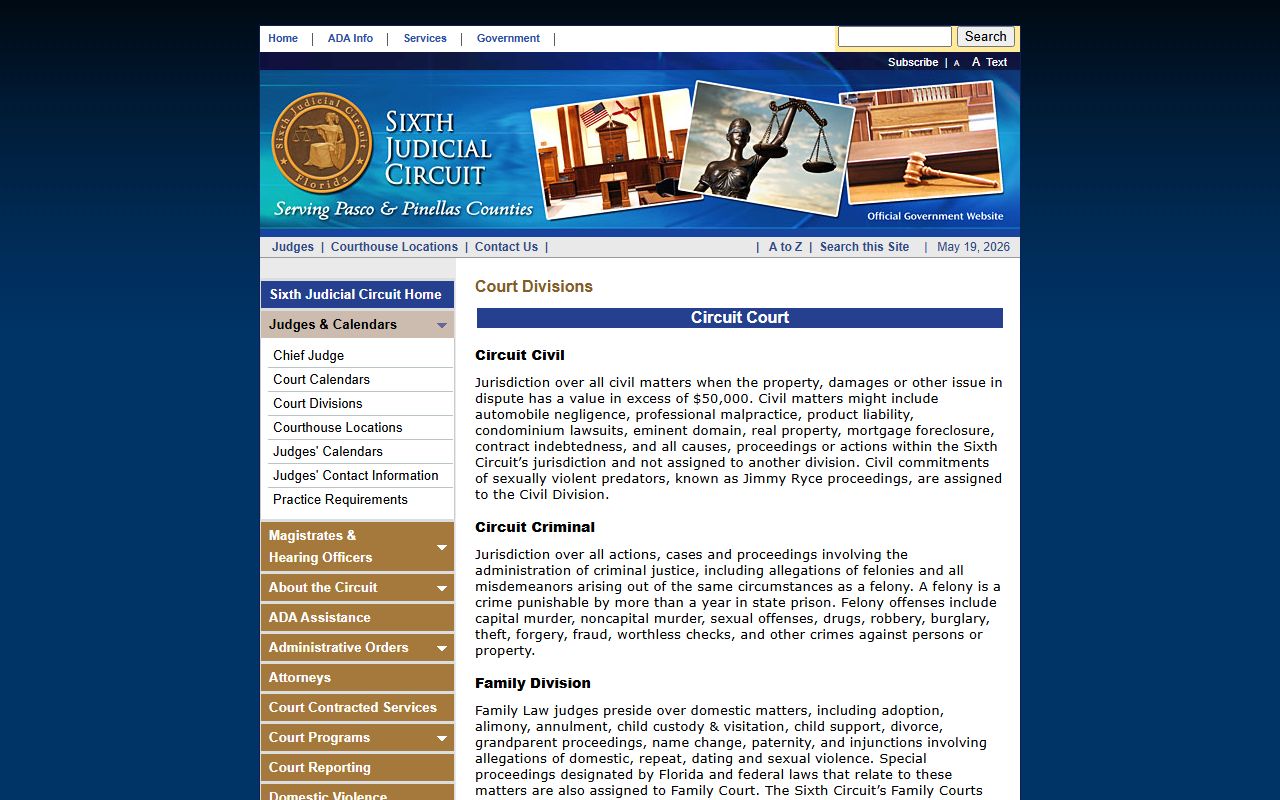
The court divisions page outlines the jurisdiction lines that determine whether a case is heard in circuit court or county court in Pinellas and Pasco counties.
Pinellas County Circuit Court Building Locations
Circuit court users in Pinellas need to know which building handles their matter. The county does not operate from a single courthouse. Civil users, criminal defendants, jurors, probate filers, and family court petitioners each have a primary building to visit, and branch locations exist for certain services. The Sixth Judicial Circuit publishes an official addresses and directions page that lists all Pinellas and Pasco court facilities.
| Building | Address | Phone | Primary Use |
|---|---|---|---|
| Clearwater Courthouse | 315 Court Street, Clearwater, FL 33756 | (727) 464-7000 | Circuit/County Civil, Family, Probate, Official Records, Recording, Administrative Offices |
| Pinellas County Justice Center | 14250 49th Street North, Clearwater, FL 33762 | (727) 464-7000; Jury (727) 464-6423 | Circuit Criminal, County Criminal, Criminal Court Records, Jury Service |
| St. Petersburg Judicial Building | 545 1st Avenue North, St. Petersburg, FL 33701 | (727) 582-7941 (Self Help) | South County court services, Self Help Center Room 103 |
| Clearwater Historic Courthouse | 324 South Fort Harrison Avenue, Clearwater, FL 33756 | See Sixth Circuit page | Historic courthouse listed by Sixth Circuit; verify current use before visiting |
| North County Branch / Fessler Center | 3165 McMullen Booth Road, Building B, Clearwater, FL 33761 | See Clerk contact page | Public terminals, branch services for North County residents |
The Sixth Circuit Addresses and Directions page lists current addresses and directions for all Pinellas and Pasco court facilities.
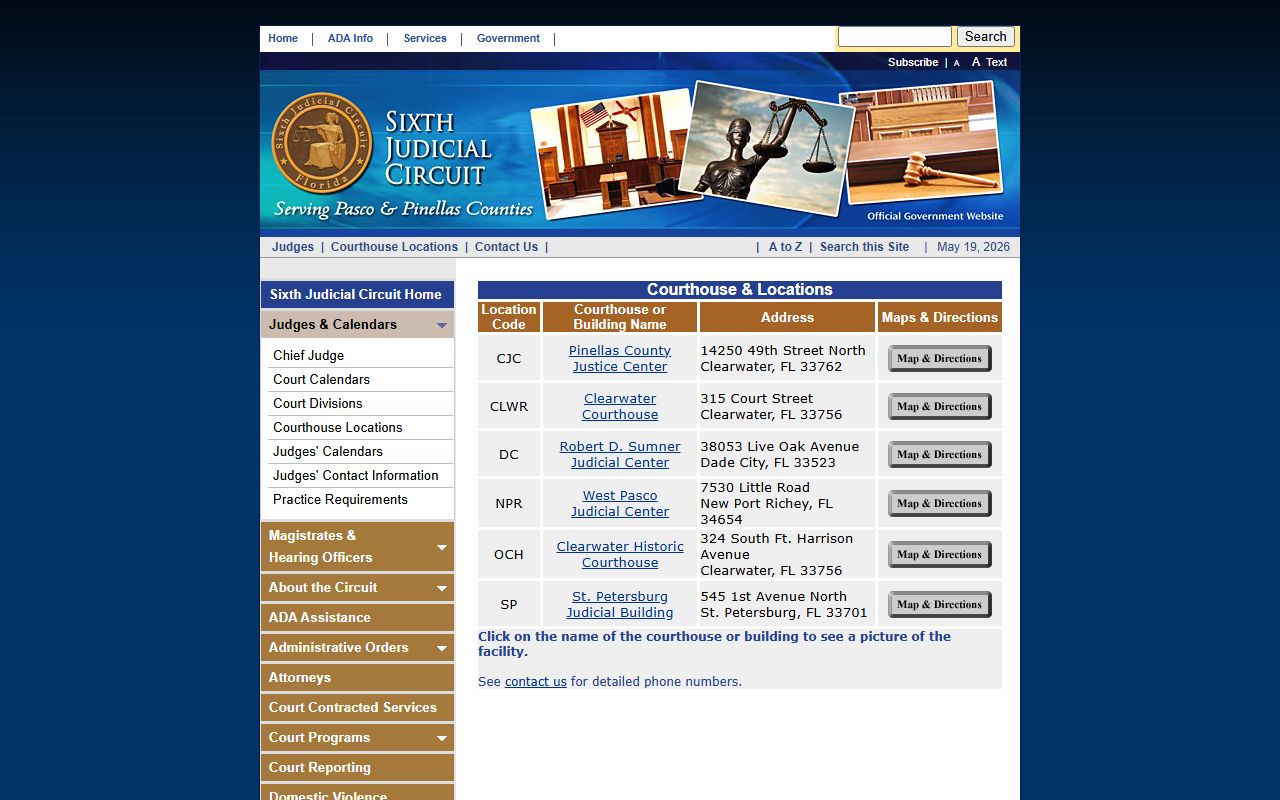
Use the addresses page to confirm which building handles your specific case type before traveling to any Pinellas courthouse location.
Map: Clearwater Courthouse Location
The Clearwater Courthouse at 315 Court Street is the primary civil, probate, and family court facility for Pinellas County. It sits in downtown Clearwater near the historic courthouse and county government buildings. The map below shows the location relative to downtown Clearwater streets and the surrounding area.
The Google Maps listing for 315 Court Street, Clearwater, FL provides driving directions and transit options from across the county.
From U.S. 19, travel west on Gulf to Bay Boulevard toward downtown Clearwater and follow signs to Court Street and the county courthouse complex. From South Pinellas, I-275 and Roosevelt Boulevard connect to routes reaching downtown Clearwater.
Circuit Court vs. County Court in Pinellas
Florida's two-tier trial court system means that not every case goes to circuit court. The jurisdictional line between Circuit Court and County Court is defined by dollar amounts, charge levels, and case type. Understanding the difference matters if you are searching for a case because a civil dispute under $50,000 will appear in County Court records, not Circuit Court. A misdemeanor with no concurrent felony will be a County Court criminal case. The table below shows how the two courts divide their work in Pinellas County. Florida does not have a separate Justice Court or Justice of the Peace court; county courts handle the functions that JP courts handle in other states.
| Circuit Court | County Court | |
|---|---|---|
| Civil jurisdiction | Cases over $50,000; real property; foreclosure; eminent domain; equity; complex civil litigation | Cases up to $50,000; landlord-tenant; small claims up to $8,000; simplified dissolution |
| Criminal jurisdiction | Felonies (all degrees); misdemeanors arising from the same circumstances as a felony charge | Misdemeanors without concurrent felony; county and municipal ordinance violations; criminal traffic |
| Family cases | Yes: divorce, custody, paternity, adoption, juvenile delinquency and dependency, injunctions, termination of parental rights | Limited: simplified dissolution; some landlord-tenant family issues |
| Probate and guardianship | Yes: estates, wills, trusts, guardianship, incapacity, Baker Act, Marchman Act | No |
| Traffic cases | Criminal traffic charges requiring jury trial; DUI and felony traffic cases | Civil traffic infractions; criminal traffic misdemeanors; ordinance violations |
| Small claims | No | Yes: disputes of $8,000 or less excluding costs, interest, and attorney fees |
| Jury size (criminal) | 6 jurors (most felonies); 12 jurors (capital cases) | 6 jurors |
| Appeals from here go to | District Court of Appeal, Second District | Circuit Court (circuit appellate jurisdiction) or District Court of Appeal |
For County Court records, small claims information, and misdemeanor case lookups, see the Pinellas County Court page. For all circuit-level cases, use the Pinellas Clerk Court Records portal.
How a Pinellas Circuit Court Case Moves Through the System
Criminal and civil cases follow different paths through the Pinellas Circuit Court. A criminal felony case begins at arrest, moves through first appearance and bond review, and then proceeds through formal charging, arraignment, and pretrial stages before reaching trial or a negotiated plea. Civil cases start with a filed petition or complaint and move through service, answer, discovery, and often mediation before any trial. Both types of cases end with a judge's decision that may be appealed to the District Court of Appeal.
Criminal flow (circuit criminal): Arrest › First Appearance / Bond Hearing › Information or Indictment › Arraignment › Pretrial Motions › Trial or Plea › Sentencing › Appeal to District Court of Appeal
Civil flow (circuit civil): Complaint Filed › Summons Issued › Service of Process › Answer / Response › Discovery › Mediation › Trial or Settlement › Judgment › Appeal to District Court of Appeal
Family flow: Petition Filed › Service on Respondent › Financial Affidavits / Required Documents › Mediation if Required › Hearing or Final Hearing › Final Judgment › Enforcement / Modification Proceedings
Case records for each stage of these flows are maintained by the Clerk of the Circuit Court and Comptroller. Docket entries showing each filing, motion, and order appear in the court dockets and the public view portal. For pending appearance dates, the Clerk's Court Calendar option is the correct tool rather than reading through the full docket manually.
Pinellas County Circuit Court Specialty Programs
The Sixth Judicial Circuit operates several specialty court programs in Pinellas County that run alongside the standard criminal, civil, and family dockets. These programs are not simply alternative dockets. Each involves structured participation requirements, regular court appearances, monitoring, and often community resources like treatment, counseling, or arbitration services. Successful completion of a specialty program can earn a case dismissal or a different outcome than standard prosecution or litigation.
The Sixth Circuit Court Programs page lists and describes each program available to eligible participants in Pinellas and Pasco counties.
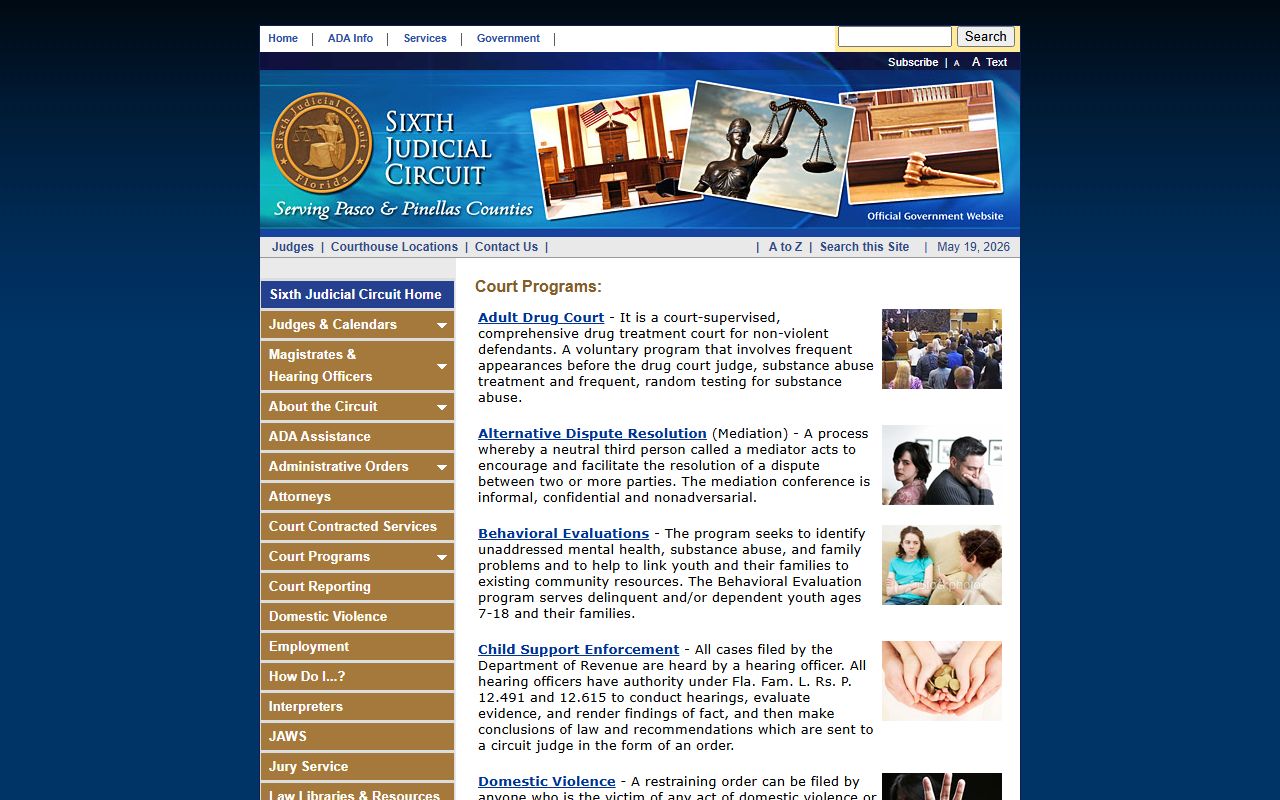
The court programs page explains eligibility, participation requirements, and how each specialty court program operates within the Sixth Judicial Circuit's Pinellas division.
- Adult Drug Court: A court-supervised, voluntary program for non-violent defendants with substance abuse issues. Participants appear frequently before the drug court judge, complete substance-abuse treatment, and submit to random testing. It is a structured program, not just a different case assignment. Referral through the court or State Attorney's Office.
- Unified Family Court (UFC): Pinellas County's Unified Family Court includes four judges, one general magistrate, behavioral evaluation services, and juvenile arbitration. UFC consolidates multiple cases involving the same family before one judge when possible. It handles juvenile delinquency, dependency, adoptions of minors, termination of parental rights, temporary custody under Chapter 751, and judicial waiver matters. The goal is coordinated case management to reduce conflicting orders and improve outcomes for families with multiple pending matters.
- Juvenile Arbitration / STOP / Juvenile Drug Court: The Juvenile Arbitration Program serves first-time juvenile misdemeanor offenders; successful completion can earn dismissal. STOP is a longer-term intensive arbitration program for repeat misdemeanor and certain third-degree felony juveniles. Juvenile Drug Court applies to juveniles charged with misdemeanor or felony drug offenses; completion can earn dismissal. These programs are referral-based and involve close monitoring.
- Teen Court / Teen Traffic Court / Truancy Teen Court: Teen Court interrupts developing patterns of juvenile criminal behavior through a peer-based process. Teen Traffic Court may handle certain juvenile traffic offenses. Truancy Teen Court addresses students with patterns of unexcused absences.
- Community Violence Court: The 2025 Pinellas judicial assignment orders identify Community Violence Court sections handling dating, domestic, repeat, and sexual violence injunction hearings, Jimmy Ryce commitment cases, and related specialty matters. A separate section handles Marchman Act petitions, risk protection orders, and firearm disability cases within the probate specialty.
- Mediation: The Sixth Circuit describes mediation as an alternative to full trial in civil and family matters. A neutral mediator works with parties to reach a settlement. Many circuit civil cases and family cases include a mandatory mediation step before trial is set.
ADA Assistance and Accessibility at Pinellas Circuit Court
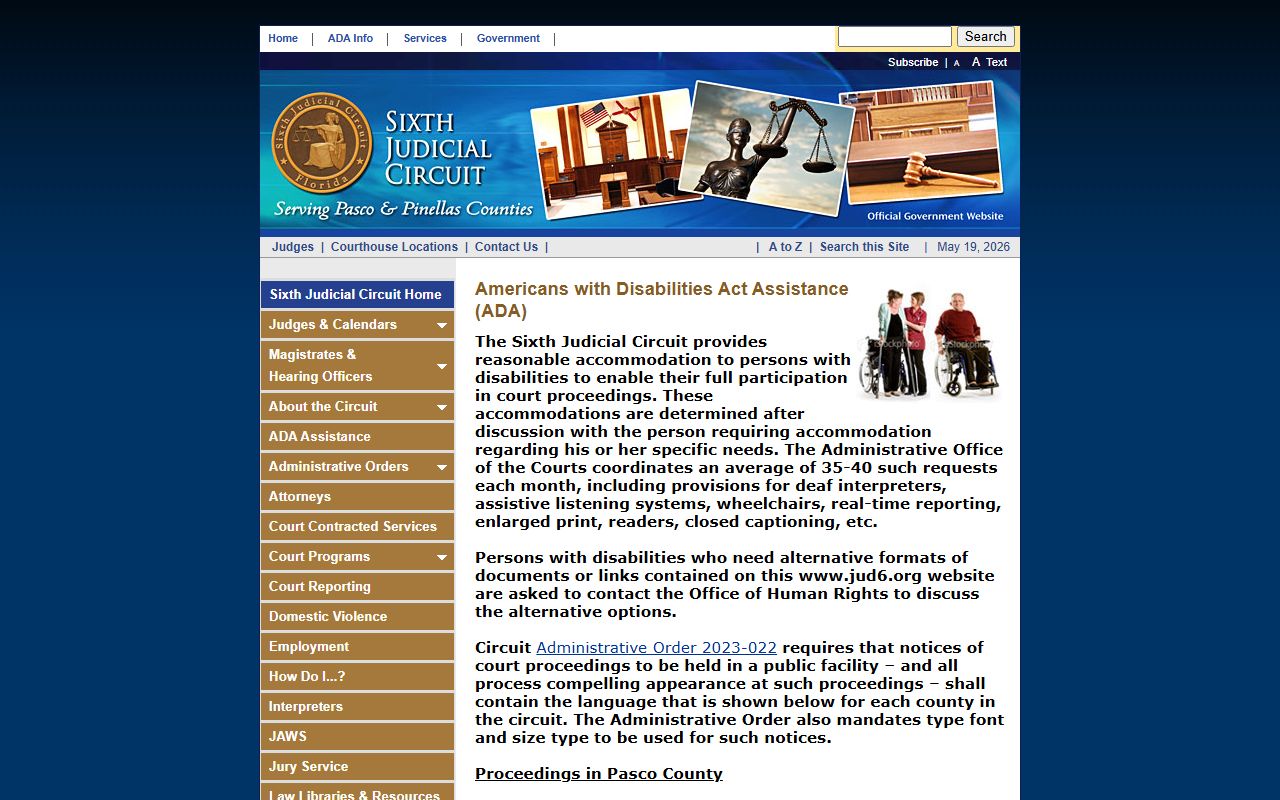
The Sixth Judicial Circuit provides reasonable accommodations to court users with disabilities. The circuit's ADA assistance page states the circuit evaluates specific needs on request and can provide deaf interpreters, assistive listening systems, wheelchairs, real-time reporting, enlarged print, readers, and closed captioning. The circuit reports receiving approximately 35 to 40 accommodation requests per month on average, which reflects active use of these services in Pinellas and Pasco courts.
The Sixth Circuit ADA Assistance page provides contact information for requesting accommodations before a hearing date.
Request accommodations in advance through the ADA page so the court can evaluate the specific need and arrange services before the hearing date. Walk-up accommodation requests on the day of a hearing may not be fulfilled as completely as advance requests.
Assisted listening systems are installed in all courtrooms at the Pinellas County Justice Center. The Clerk also has separate accessibility policies for records access and service delivery at Clerk locations. For accommodations at a Clerk office, contact the Clerk at (727) 464-7000.
Representing Yourself in Pinellas Circuit Court
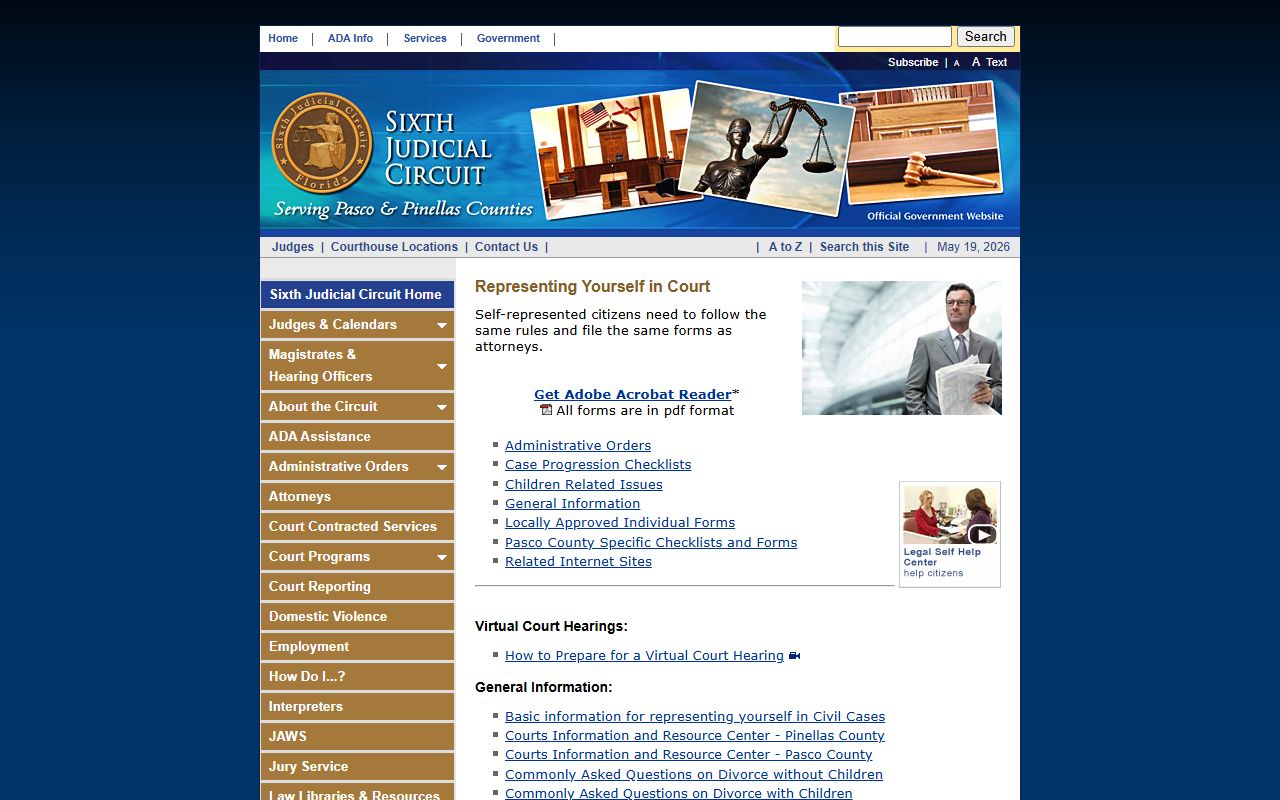
The Sixth Judicial Circuit's self-represented litigant resources are available to people who do not have a private attorney. The circuit makes clear that self-represented parties must follow the same rules and file the same forms as attorneys. There is no relaxed standard for pro se litigants in how they file documents or appear in court. The Sixth Circuit's "Representing Yourself in Court" page links administrative orders, case-progression checklists, children-related filing guidance, locally approved forms, related sites, and virtual hearing preparation materials.
The Representing Yourself in Court page is the official starting point for self-represented parties navigating Pinellas Circuit Court filings.
Self-represented parties who need help with forms or procedures can also use the Clerk's Legal Self Help Center, which offers low-cost attorney consultations for family law, small claims, and landlord-tenant matters at Clearwater Courthouse Room 114 and St. Petersburg Judicial Building Room 103.
The Clerk Self Help Center provides affordable legal assistance but cannot give legal advice. Consultations are available for a minimum of $15 in the listed practice areas only. Telephonic appointments are available. For civil legal aid at no cost, eligible residents can contact Community Law Program, Gulfcoast Legal Services, or Bay Area Legal Services.
Appeals from Pinellas Circuit Court
Most appeals from Pinellas Circuit Court decisions go to the Florida District Courts of Appeal. Florida has six districts. The Second District Court of Appeal has historically served the Sixth Judicial Circuit, including Pinellas and Pasco counties. Under Florida's appellate framework, circuit court final judgments and orders that resolve the case are generally appealed to the appropriate district court. Non-final orders may be reviewed only when Florida Rule of Appellate Procedure 9.130 permits.
County Court orders may route through the circuit court's appellate jurisdiction in some categories before going to the District Court of Appeal. Once a case reaches the District Court of Appeal, further review by the Florida Supreme Court is available only on certified questions of great public importance, direct conflict with another district court's decision, or specific categories of cases such as capital sentences and bond validation matters.
Federal appeals from the U.S. District Court for the Middle District of Florida, Tampa Division, which covers Pinellas, go to the U.S. Court of Appeals for the Eleventh Circuit. Federal court records are separate from Pinellas Clerk records and are searched through PACER. See the court records page for more on the distinction between state and federal court access in Pinellas.
Pinellas County Circuit Court History
Pinellas County was created in 1912 after separating from Hillsborough County. Clearwater became the county seat, and early courthouse arrangements were temporary. By 1916, county commissioners approved a bond issue for a permanent courthouse and jail. The Old Pinellas County Courthouse was designed by architect Francis J. Kennard and built in the late 1910s, with additions completed in 1924 and 1926. That building was added to the National Register of Historic Places in 1992 and still stands near the modern courthouse complex on South Fort Harrison Avenue.
Florida's modern trial court structure, including the current two-tier system of circuit and county courts, took shape through constitutional and legislative reorganization over the twentieth century. Pinellas grew into a high-volume urban court system that now operates five facilities and handles tens of thousands of cases annually. The Sixth Circuit identifies itself as nationally recognized for court automation and electronic access, with systems including online court records, E-Notify court-event reminders, electronic filing, and the online copy request process.
The Sixth Circuit in Pinellas has also attracted national attention through specific cases. The Terri Schiavo end-of-life litigation was decided by Pinellas-Pasco Circuit Court judges and drew coverage across the country. The case illustrates that Pinellas court history includes not only local record volume and automation milestones but also decisions of national legal significance handled in these Clearwater and Justice Center courtrooms.
Searching Pinellas County Circuit Court Records
Circuit court records are maintained by the Clerk of the Circuit Court and Comptroller, Ken Burke, CPA. The Clerk's Court Records Public View portal is the free, no-login starting point for many criminal, civil, and traffic case records. Family and probate case documents require registered user access, and juvenile records are not available online. Dockets for circuit civil, circuit criminal, and traffic cases are generally searchable by party name or case number.
Case numbers in Pinellas follow a format that includes the year, a sequence number, and a case type suffix. A circuit criminal case might show as 25-01828-CF-1 in the Clerk's local format, while the uniform statewide case number might be longer, such as 522020CF000088000APC. Traffic infractions and county court misdemeanors use different suffix codes. Knowing whether you are looking for a CF (felony), MM (misdemeanor), or CA (circuit civil) case helps narrow the search.
For certified or conformed copies of circuit court documents, use the Clerk's public request center or visit the Clerk office that handles the relevant division. The Clerk fee schedule lists court-record copy fees of $1.00 per page and $2.00 for certification. Record searches performed by Clerk staff cost $7.00 per name, plus $2.00 per year where a record is found.
For docket lookups and court event reminders, see court dockets. For details on the Clerk office itself, fees, and request procedures, see the Clerk of the Circuit Court and Comptroller page. For probate and guardianship records, see probate records.