
How to Find Recently Released Pinellas County Inmates
The Pinellas County Sheriff's Office arrest inquiry is the official starting point for Pinellas County released inmates. The tool covers two groups: people who are currently in custody and people who were released within the last 30 days. The system is free and does not require an account. You can search by last name, first name, docket number, booking date, race, sex, arresting agency, charge type, or arrest type. Checking the alias search box helps when a person may have been booked under a different name.
When a person has been released, the charge report shows the release status and date in the Cell Location/Status field. A sample report from the PCSO system shows an entry reading "RELEASED - 5/4/2026 6:17 AM," which gives the exact date and time the person left custody. That release entry does not mean the criminal case is closed. The court case number listed on the charge report connects to the Pinellas Clerk court docket, which shows whether a case is still pending, resolved by plea, dismissed, or otherwise disposed. Check the Pinellas County criminal records page for guidance on reading court docket entries and understanding what final disposition means.
The 30-day window is a hard limit. A person released 31 days ago may return no results even though the arrest was real and a court case may still be active. Do not assume "no result" means no arrest. The PCSO page itself warns that the information is subject to change, updated periodically, and should not be used to determine actual criminal record status. For final case outcome, the Pinellas County Clerk of the Circuit Court and Comptroller holds the court record.
The PCSO arrest inquiry also shows projected release dates for current inmates when a date has been set. A value of "NONE" in the projected release date field means no release date has been entered, which can reflect pending bond, no-bond holds, or other status. The charge report includes Bond Assessed and Bond Amount Due fields that help family members understand whether bond is available and what it would cost to post.
The charge report fields on PCSO's public sample profiles include booking name, docket number, booking date, arresting agency, address (or "EXEMPT" if protected), race, sex, date of birth, place of birth, arrest age, eye and hair color, complexion, height, weight, scars and tattoos, cell location or release status, projected release date, commissary balance, SPIN number, booking type, alias names, and individual charge rows. Each charge row lists charge number, agency report number, offense description, statute, amended charge if any, court case number, bond amounts, charge status, arrest type, and OBTS number. The OBTS is the Offender Based Transaction System identifier used across Florida criminal justice agencies to track a case from arrest through disposition.
The screenshot below shows the PCSO arrest inquiry search page used to look up Pinellas County released inmates. The PCSO arrest inquiry portal is the official tool for checking current custody and recent release status within the 30-day window.
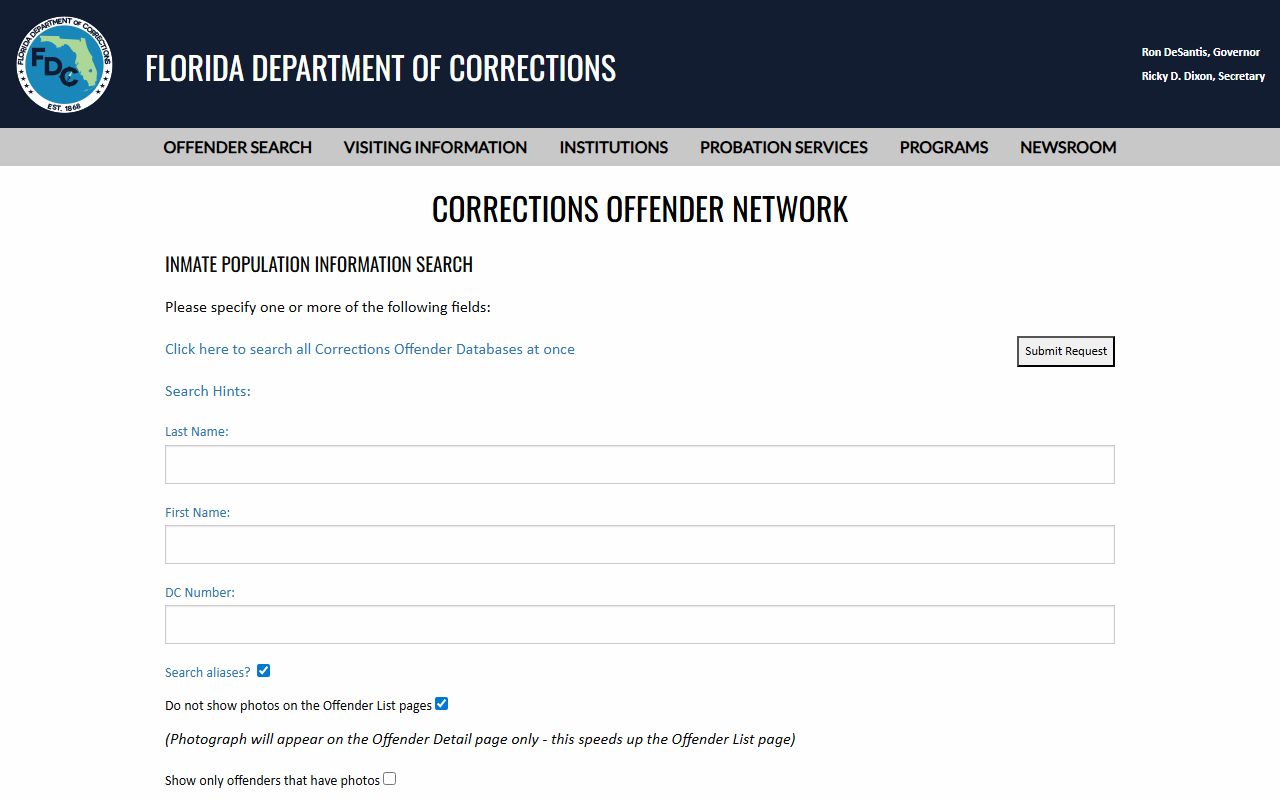
The Florida Department of Corrections inmate population search, shown above, covers individuals sentenced to state prison or state supervision, not county jail. Use it after confirming the person was transferred out of Pinellas County Jail into state custody.
Note: a release time on the PCSO report may reflect bond posted, time served, release on recognizance, sentence completion, transfer to another facility, or an administrative release. Each has different legal implications for the court case.
Reading Pinellas County Release Status on Charge Reports
A second PCSO sample report shows how current custody looks compared to a released profile. The screenshot below is drawn from an active booking record at the PCSO subject charge report page, where the cell status field may show an in-custody housing location rather than a release date and time.
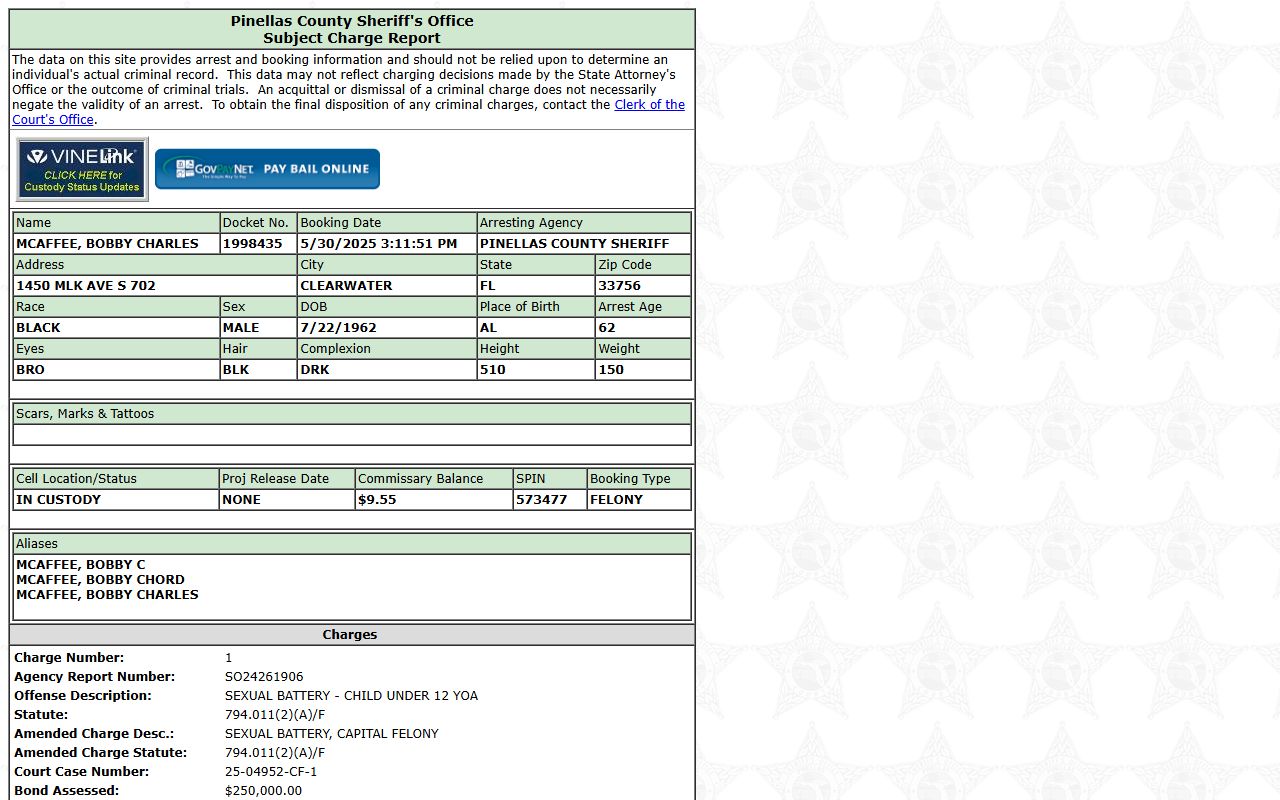
The sample report above illustrates how charge status, bond fields, arrest type, and cell location appear together on one public profile. Comparing an in-custody report with a released report helps users understand the difference between the two statuses. When bond appears as assessed but the amount due shows zero, that can mean bond was posted. When the charge status field shows a specific value such as "IN COURT" or a transfer code, that may indicate movement between facilities rather than final release from the system.
Because PCSO's disclaimer notes the data may not reflect State Attorney charging decisions or trial outcomes, always cross-check with the Pinellas Clerk for final disposition. An acquittal, nolle prosequi, or dismissal at the court level does not automatically remove a booking entry from PCSO's public system.
Requesting Older Pinellas County Booking Records
When the release happened more than 30 days ago, the PCSO arrest inquiry will not show the record. The official path is to request older booking information through the PCSO Records Request Portal. This is the same portal used for other Pinellas County public records requests, and PCSO will quote copy costs by email after reviewing the request.
When submitting a records request for an older booking, include as much identifying information as possible. The PCSO arrest inquiry uses last name, first name, docket number, and booking date as its primary search fields, so providing any of those you know will speed up the process. Race, sex, and date of birth can also help staff locate the correct record when the name is common. The portal sends a response to the email address you provide, so use one you check regularly.
- Go to the Pinellas public records request portal and start a new request.
- Select the Sheriff's Office as the agency or describe the record type as a jail booking record.
- Provide the subject's full name, approximate booking date, and docket number if known.
- Include your email address. PCSO will send a cost quote or the record to that address.
- Pay any applicable copy fees when invoiced, then download or receive the record.
For court case outcomes tied to old bookings, the Pinellas Clerk at (727) 464-7000 can help locate the case by name or docket number. The court record is the definitive source for charges filed, plea or trial outcome, and sentence. For more on what the inmate profile shows during active custody, see the Pinellas County inmate records page.
Setting Up Pinellas County Release Notifications
VINELink is a free custody notification system that allows victims, family members, and others to sign up for alerts when an inmate's custody status changes. The system is supported by the National Center for Victims of Crime and is used across Florida agencies. When an agency in the VINELink network updates a person's custody record, registered users receive an automatic alert by phone, text, or email.
VINELink is best used as a notification tool rather than a primary research source. Its coverage varies by agency and state, so confirm that Pinellas County Sheriff's Office data is included before relying on it for active monitoring. The screenshot below shows the VINELink landing page at vinelink.com, where you can search by person name and state to start the registration process.
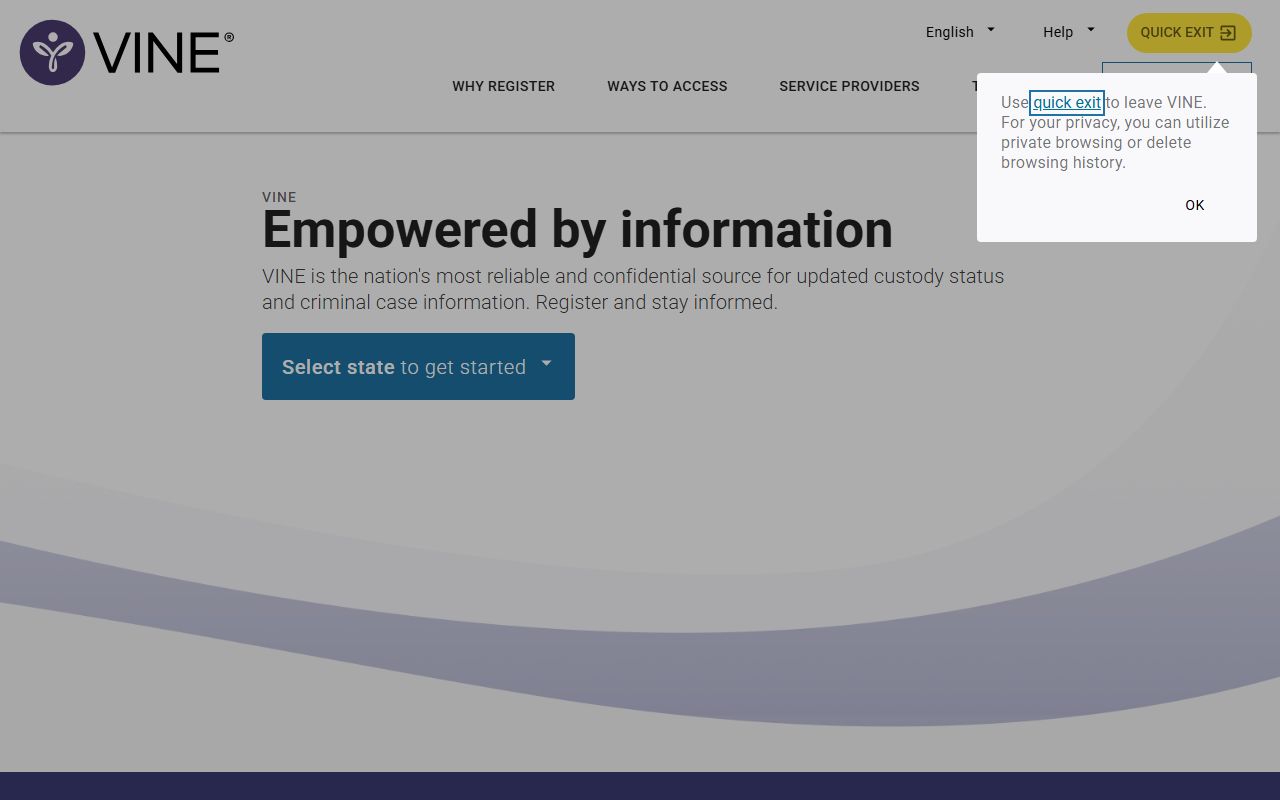
VINELink sends notifications when status changes occur, but it does not replace checking the PCSO arrest inquiry directly for current custody. Use both tools together for the most complete picture of a person's release status.
- Visit vinelink.com and select Florida from the state list.
- Search by the person's name to locate the custody record in the VINELink database.
- Select the correct person from the search results.
- Register with a phone number or email address to receive alerts when custody status changes.
- Confirm registration and keep your contact information current so alerts reach you.
Searching State and Florida DOC Released Inmates
The Florida Department of Corrections inmate population search covers individuals who have been sentenced to state prison or placed on state supervision such as probation or community control through the Florida DOC. It does not include people who are or were held only at the county jail level. If a Pinellas County Jail inmate was sentenced to state prison after conviction, they would be transferred to DOC custody and then would appear in the FDOC locator rather than the PCSO system. People on county probation supervised by the county rather than DOC will also not appear in this search.
The FDOC locator is free and returns results by name or DC number. Results include current status, sentence information, and any supervision details. The search below shows the fields available on the FDOC inmate population search page. The screenshot above in the first section shows the FDOC search portal interface.
| Field Label | Type | Required | Notes |
|---|---|---|---|
| Last Name | Text | One or more fields | Returns names beginning with entered letters; broad searches return more results. |
| First Name | Text | Optional | Begins-with matching; leave blank to cast a wider net. |
| DC Number | Text | Optional | Six characters; all numeric or one alpha plus five numeric. Use if you have the DOC-assigned number. |
| Search aliases? | Checkbox | Optional | Check to include alias names in the search, useful when the booking name differs. |
| Do not show photos on Offender List pages | Checkbox | Optional | Speeds list display; photo still appears on the individual detail page. |
| Show only offenders that have photos | Checkbox | Optional | Limits results to profiles with a photo on file. |
| Limit matches per page | Dropdown | Optional | 10, 15, 20, 25, 30, 35, 40, 45, or 50 results per page. |
People released after serving a state prison sentence may still show in the FDOC locator with a "Released" status and a release date. If someone is on state probation or community control after a Pinellas County conviction, they may also appear with supervision status and an assigned officer's district. The FDOC locator is one of several databases needed for a complete picture of a person's Florida custody and supervision history.
Federal Bureau of Prisons Locator
When a person was charged in federal court rather than Pinellas County circuit or county court, their custody and release information will be in the Federal Bureau of Prisons inmate locator rather than any state or county system. The BOP locator is free and covers federal inmates from 1982 to the present. No Pinellas County federal prison facility was identified in official sources, so federal inmates connected to Pinellas cases are held at facilities outside the county. Pinellas County federal cases are prosecuted by the U.S. Attorney's Office for the Middle District of Florida and handled at the Sam M. Gibbons U.S. Courthouse in Tampa.
The BOP locator screenshot below, from bop.gov/inmateloc, shows the two search tabs: Find By Number and Find By Name. Each tab has its own required fields. BOP result records show name, register number, age, race, sex, release date, and location. BOP warns that release dates may change due to First Step Act sentence recalculations and that a "Released" or "Not in BOP Custody" status may still mean the person is in another jurisdiction's custody, on parole, or on supervised release rather than fully free.
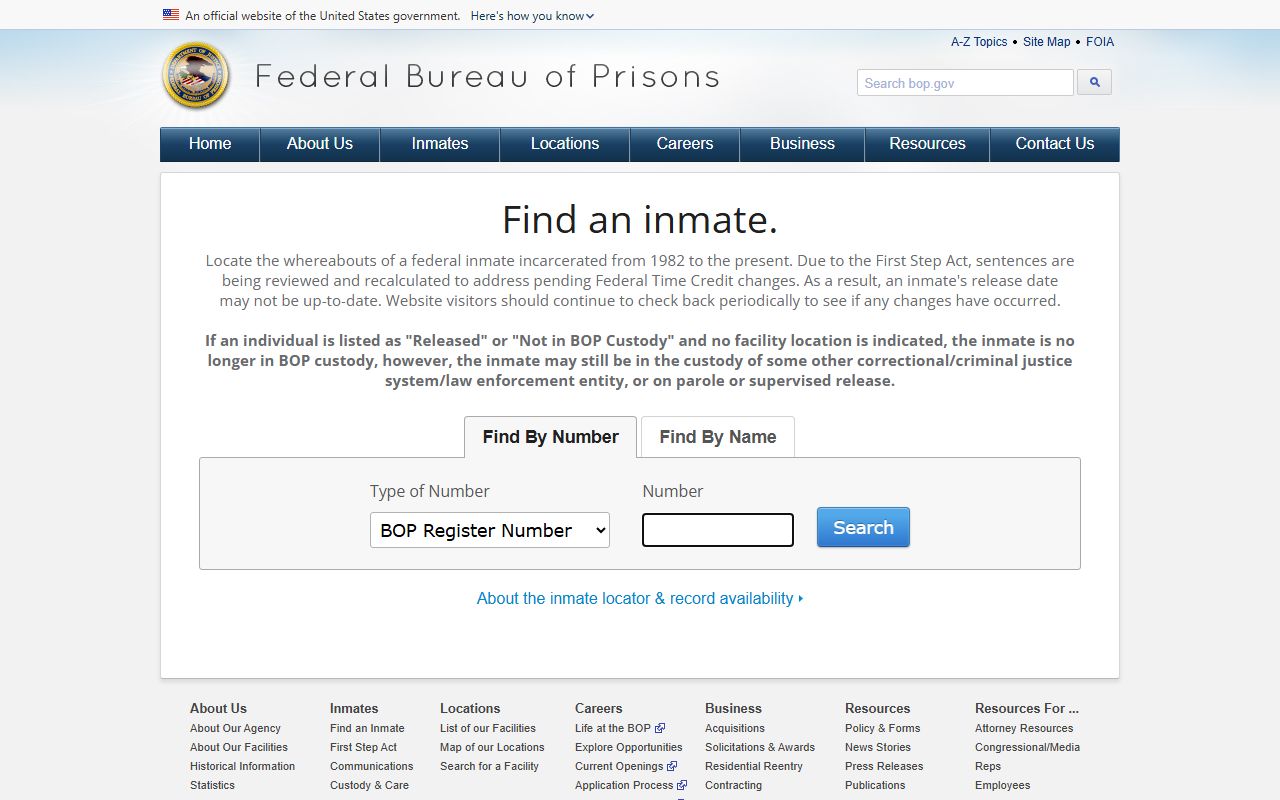
The BOP locator is the correct tool for confirming when a federal sentence was completed and where the person was held before release.
| Field Label | Type | Required | Notes |
|---|---|---|---|
| Find By Number tab | Tab | Optional | Use when you have a BOP Register Number, DCDC Number, FBI Number, or INS Number. |
| Type of Number | Radio/Dropdown | Yes (number search) | Register number format is #####-###; select the correct number type before entering. |
| Number | Text | Yes (number search) | The actual number value; required when searching by number tab. |
| Find By Name tab | Tab | Optional | First and Last name are required in the name search tab. |
| First | Text | Yes (name search) | Required in the name search tab. |
| Middle | Text | Optional | Middle name; not required but can narrow results for common names. |
| Last | Text | Yes (name search) | Required in the name search tab. |
| Race | Dropdown | Optional | American Indian, Asian, Black, White; optional filter to narrow results. |
| Age | Text/Number | Optional | Enter age to help distinguish people with the same name. |
| Sex | Dropdown | Optional | Male or Female; optional filter. |
Verifying Pinellas County Release By Phone
When online searches do not produce a clear result, call the Pinellas County Jail information line directly. The jail phone number is (727) 464-6415. Staff can confirm whether a specific person is currently in custody, has been released, or has been transferred. This is the most direct way to verify Pinellas County released inmate status without waiting for an online record to update.
If you are calling about an older booking and need records rather than just status, ask to be directed to the PCSO records unit or use the public records portal described in the section above. The Clerk of the Circuit Court and Comptroller can be reached at (727) 464-7000 for court case outcome questions. Court records show final disposition, while PCSO records show booking and custody. Both are needed for a complete picture. For visitation-related questions, a separate line is available at (727) 464-7467.
In-person verification is another option. The Pinellas County Jail is located at 14400 49th Street North, Clearwater, FL 33762-2877. Family members who need to confirm release or retrieve personal property should call ahead to confirm current procedures, as the jail does not publish specific release-door logistics or personal property pickup hours in the official sources available.
Florida Sex Offender Registry After Release
The Florida Department of Law Enforcement sex offender and predator registry is a separate tool from the PCSO release roster. It shows individuals who are required by Florida law to register as sexual offenders or sexual predators, and it applies after release. Registry presence is not a general criminal history record. A person may have left the Pinellas County Jail and not be on the registry, or may be on the registry after a sentence served years ago. The two are different legal categories. Under Florida law, misuse of registry data is illegal under Florida Statutes Section 775.21(10)(d).
The FDLE registry screenshot below, from offender.fdle.state.fl.us, shows the search categories available on the registry landing page. Positive identification of a registered offender always requires fingerprint comparison; the registry listing alone is not definitive identification. FDLE updates the registry regularly but warns that data can change quickly, and registry entries may not reflect the entire criminal history of the listed person. For questions about registry compliance or reporting, the FDLE Hotline is 1-888-FL-PREDATOR.
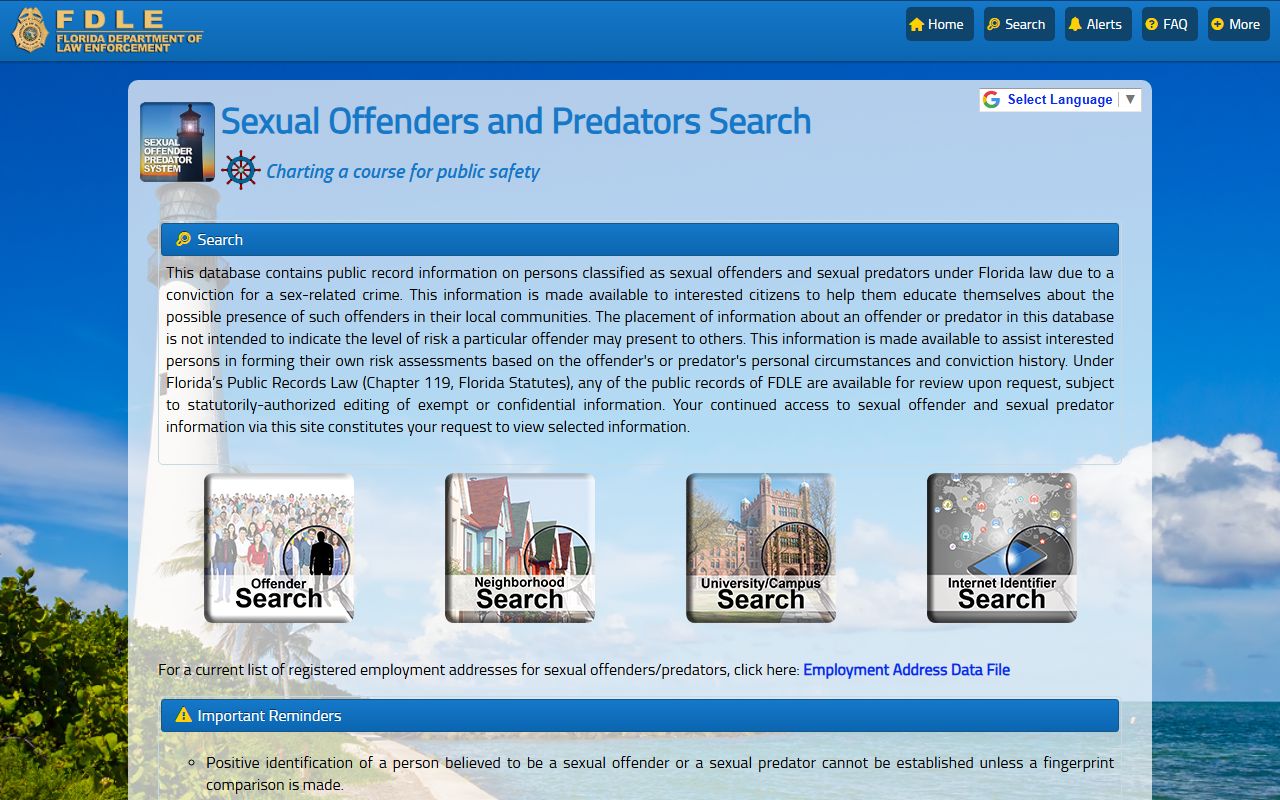
The FDLE registry provides public record information on persons classified as sexual offenders or sexual predators. Use it specifically to check registration status, not as a general inmate search tool.
| Search Category | Type | Notes |
|---|---|---|
| Offender Search | Name-based search tab | Search by name for offenders and predators required to register in Florida. |
| Neighborhood Search | Address/radius search tab | Search by address and radius to see registered persons near a location. |
| University/Campus Search | Campus search tab | Find registered persons associated with a specific campus. |
| Internet Identifier Search | Online identifier query | Search by email address or other internet identifier linked to a registrant. |
| Offender Alerts | Signup link | Register for Florida Offender Alert notifications when new registrants appear in your area. |
Parole and Probation in Pinellas County After Release
Florida abolished traditional parole for most offenses committed after October 1, 1983. People who were convicted before that date and sentenced under the old law may still be under parole supervision by the Florida Commission on Offender Review, which handles parole, conditional release, control release, addiction-recovery supervision, and other release types for eligible individuals. Most people released from the Pinellas County Jail or Florida state prisons today are not on traditional parole. They may be on probation, community control, conditional release, or supervised release terms imposed by the sentencing court.
Probation in Florida is supervised by the Florida Department of Corrections for state sentences and by county probation programs for certain county-level sentences. Pinellas County Sheriff's Office operates a Misdemeanor Probation Office that handles some county-level supervision. Violations of probation or community control can result in a new arrest, and the PCSO arrest inquiry arrest type field includes "948.06-VOP" to flag violation-of-probation arrests. When searching for a Pinellas County released inmate who may be on supervision, check both PCSO for any new arrests and FDOC for current supervision status if the sentence was at the state level.
Florida Commission on Offender Review
4070 Esplanade Way
Tallahassee, FL 32399
(850) 488-1293
For county-level probation questions related to a Pinellas case, contact the Pinellas County Sheriff's Office at (727) 582-6200 or the Clerk of the Circuit Court and Comptroller at (727) 464-7000 for court-ordered supervision questions tied to specific case numbers.
Reentry Resources in Pinellas County
Pinellas County has several programs and organizations that help people leaving the jail or state prison reintegrate into the community. Housing, employment, mental health, substance use, and legal support are all part of the reentry picture. The earlier in the reentry process a person connects with these resources, the better the outcomes tend to be. Discharge planning at the Pinellas County Jail includes program connections through the jail's own services.
Pinellas Safe Harbor is operated with support from PCSO, the Public Defender's office, WestCare, Metropolitan Ministries, Pinellas County Health and Human Services, ELEOS Wellness, and the Homeless Leadership Alliance. Safe Harbor serves as both an emergency homeless shelter and a jail diversion portal, and it specifically describes itself as a "portal for inmates re-entering our community from the Pinellas County Jail." People released without a place to stay can be connected to Safe Harbor services through the jail's discharge planning process.
The legal aid organizations listed below provide civil legal help. They do not handle criminal defense, but they assist with housing disputes, family matters, public benefits, identification documents, and expunction of eligible criminal records after release. Expunction and sealing can be critical steps for people trying to get housing or employment after a Pinellas arrest.
Community Law Program
501 First Ave N, Room 519
St. Petersburg, FL 33701
(727) 582-7480
Free civil legal help for financially eligible Pinellas residents, including expunction clinics, bankruptcy, family law, and housing.
Gulfcoast Legal Services
Serves Pinellas County
Housing stability, family law, immigration, public benefits, elder law, birth certificate and ID project.
Bay Area Legal Services
Serves Pinellas and surrounding counties
Free civil legal help for eligible residents; also serves seniors and veterans statewide.
The Sixth Judicial Circuit Public Defender's office, led by Sara Mollo, represents indigent defendants in criminal cases in Pinellas and Pasco counties. For people who were released and have ongoing criminal cases, the Public Defender can continue representation through the court process. For people seeking expunction or sealing of a past Pinellas record, the Community Law Program runs dedicated clinics focused on criminal records relief.
The Clerk's Self Help Center at Clearwater Courthouse Room 114 provides low-cost attorney consultations for family law, small claims, and landlord-tenant matters. After release, housing and family matters often need attention quickly, and the Self Help Center is a low-barrier starting point for people who cannot afford a private attorney.
Civil Rights Restoration After Pinellas County Release
Civil rights affected by a Florida felony conviction include voting rights, the right to hold public office, the right to serve on a jury, and firearm rights. Florida law on rights restoration changed significantly with the passage of Amendment 4 in 2018 and subsequent legislative action. For most felony offenses other than murder and felony sexual offenses, voting rights are now restored automatically upon completion of sentence, including prison, parole, probation, and all financial obligations such as fines, fees, restitution, and court costs. People with murder or felony sexual offense convictions must apply for clemency separately.
Financial obligations are part of the sentence under Florida law. An unpaid fine, fee, or restitution amount can prevent automatic voting rights restoration even after physical release from custody. People uncertain about their status can contact the Florida Division of Elections or the Florida Office of Executive Clemency for current eligibility guidance. The Florida Rights Restoration Coalition also provides information about the restoration process. Do not rely on informal sources for voting eligibility; use official state channels because the rules continue to be interpreted and updated.
Firearm rights are not automatically restored by completion of sentence in Florida. A person convicted of a felony in Florida or elsewhere is generally prohibited from possessing firearms under both state and federal law unless rights have been specifically restored through a court order or clemency. Florida Statutes Section 790.23 governs felon firearm possession. Federal law under 18 U.S.C. 922(g) also applies independently. Restoration of firearm rights requires a separate legal process and is not part of the automatic voting-rights restoration rules. Anyone seeking firearm rights restoration after a Pinellas felony conviction should consult a licensed attorney before taking any action.
Sealing and expunction of Pinellas County criminal records can help with employment and housing after release, though they do not change the underlying conviction or eliminate all consequences. The Clerk's View Records page explains the two-step process: first obtain a Certificate of Eligibility from FDLE by mailing an application, fingerprint card, certified disposition documents, and a $75 fee to FDLE; then file the certificate with the Pinellas Clerk and pay the $42 Clerk filing fee. A judge decides whether to grant the petition after the State Attorney has an opportunity to respond. Upon a granted order, the Clerk removes the information from the judicial record and forwards certified copies to appropriate agencies. Common reasons for denial include ineligible charges, a prior sealing or expunction, open charges, or missing documents. For help with the process, contact the Community Law Program or another qualified legal aid organization in Pinellas County.